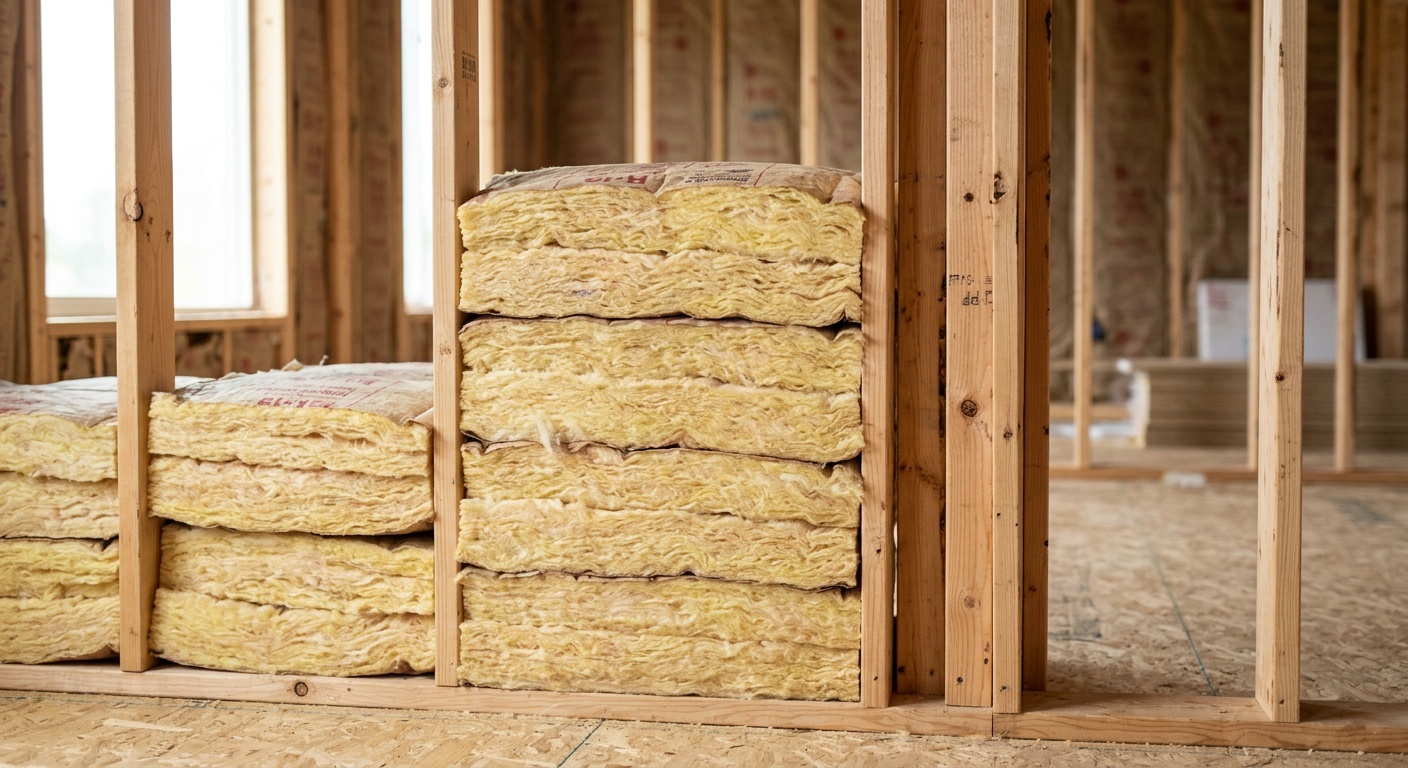
Best Insulation Materials for Small Homes to Reduce Heat
Best Insulation Materials for Small Homes to Reduce Heat
Reading time: 12 minutes
Ever walked into your small home on a sweltering summer afternoon and felt like you’d just stepped into a preheated oven? You’re not alone. With global temperatures hitting record highs in 2025 and energy costs continuing their upward climb into 2026, small homeowners are feeling the heat — literally and financially. The good news? The right insulation can transform your compact living space from a heat trap into a cool, energy-efficient sanctuary.
Here’s the straight talk: insulating a small home isn’t just about comfort. It’s a strategic investment that reduces your carbon footprint, slashes utility bills, and increases your property’s resale value. The challenge is knowing which materials deliver the best results for your specific situation — because not all insulation is created equal.
This guide cuts through the marketing noise to give you a precise, practical roadmap for selecting the best insulation materials tailored to small homes in 2026’s climate reality.
Table of Contents
- Why Insulation Matters More Than Ever in 2026
- Understanding R-Value: The North Star of Insulation
- Top Insulation Materials for Heat Reduction
- Side-by-Side Comparison
- Real-World Case Studies
- Performance Visualization
- Common Challenges and How to Overcome Them
- Frequently Asked Questions
- Your Heat-Free Home: Next Steps
Why Insulation Matters More Than Ever in 2026
The numbers don’t lie. According to the U.S. Department of Energy’s 2026 Residential Energy Report, heating and cooling account for approximately 43% of a typical household’s energy bill. For small homes — typically defined as under 1,000 square feet — this percentage can be even higher because the ratio of exterior surface area to interior volume is less favorable than in larger structures. In simple terms, more wall per square foot of floor space means more opportunity for heat to invade.
Meanwhile, the International Energy Agency reported in early 2026 that residential buildings globally are responsible for nearly 21% of total CO₂ emissions, with inadequate insulation being one of the primary culprits. Add to this the 2025 North American heat waves — which broke 200-year temperature records across 14 states — and the urgency becomes crystal clear.
But here’s what makes small home insulation uniquely interesting: strategic insulation in a compact space yields proportionally greater impact. A 700-square-foot home that’s properly insulated can achieve energy savings of 30–50% compared to one without, often recovering the investment cost within 4–7 years. That’s a compelling return on investment by any measure.
“Insulation is the most cost-effective single investment a small homeowner can make. In dense urban environments where compact living is growing, the energy math simply works in your favor.” — Dr. Karen Elsworth, Building Science Researcher, MIT Energy Initiative, 2025
Understanding R-Value: The North Star of Insulation
Before diving into materials, you need to understand R-value — the metric that measures thermal resistance. The higher the R-value, the better the material resists heat flow. Think of it like SPF for your home: higher numbers mean more protection.
How R-Value Works in Practice
R-value is measured per inch of material thickness. So a material with R-4 per inch installed at 3 inches thick gives you a total R-12. For small homes focused on heat reduction, the U.S. Department of Energy recommends the following minimum R-values by zone and application in 2026:
- Attic: R-38 to R-60 (most critical — heat rises)
- Exterior walls: R-13 to R-21
- Floors over unheated spaces: R-25 to R-30
- Basement walls: R-11 to R-15
The key insight for small homeowners: your attic is your biggest thermal battleground. Up to 25% of home heat gain occurs through the roof and attic in summer. Prioritizing this zone gives you the maximum return on your insulation dollar.
Beyond R-Value: What Else Should You Consider?
R-value alone doesn’t tell the whole story. You also need to consider:
- Thermal mass: Some materials absorb heat during the day and release it at night — valuable in climates with significant day-night temperature swings
- Air sealing capability: Gaps and air leaks can negate even excellent R-values. Some materials, like spray foam, seal and insulate simultaneously
- Moisture resistance: In humid climates, moisture infiltration can degrade insulation performance by up to 40% over time
- Sustainability profile: With green building codes tightening across 22 states in 2026, eco-friendly materials are increasingly preferred — and often incentivized
Top Insulation Materials for Heat Reduction in Small Homes
Let’s walk through the six most effective insulation materials for small homes focused on reducing heat gain, examining each through the lens of performance, cost, and practical application.
1. Spray Polyurethane Foam (SPF)
Spray foam is the high-performance athlete of the insulation world. Available in two forms — open-cell and closed-cell — it expands on contact to fill every crack, gap, and cavity. Closed-cell spray foam is particularly powerful for heat reduction, offering an impressive R-6 to R-7 per inch and acting as both insulator and vapor barrier simultaneously.
For a small home’s attic or wall cavities, closed-cell spray foam delivers unmatched air-sealing performance. The downside? It’s the most expensive option, running between $1.50 and $3.50 per square foot in 2026, and it requires professional installation. However, its dual-action insulation-plus-air-sealing capability often makes it the most cost-effective choice when total energy savings are calculated over a 10-year period.
Best for: Attics, crawl spaces, rim joists, and irregular cavities in small homes with complex geometry
2. Rigid Foam Board (Polyisocyanurate / XPS / EPS)
Rigid foam boards are the workhorses of exterior insulation in small homes. Three main types dominate the market:
- Polyisocyanurate (Polyiso): Highest R-value at R-5.8 to R-6.5 per inch; ideal for roofs and exterior walls
- Extruded Polystyrene (XPS): R-5 per inch with excellent moisture resistance; great for below-grade applications
- Expanded Polystyrene (EPS): R-3.8 per inch; most economical option, excellent long-term stability
Rigid foam board shines in small homes because it can be installed on exterior surfaces without reducing interior living space — a critical consideration when every square foot counts. It costs between $0.25 and $0.65 per square foot depending on thickness and type.
Best for: Exterior walls, roof decks, and basement perimeter insulation
3. Mineral Wool (Rockwool / Slag Wool)
Mineral wool has experienced a remarkable renaissance in 2025–2026, driven by its exceptional fire resistance, superior acoustic properties, and moisture-repellent nature. Made from volcanic rock or industrial slag, it offers R-3.0 to R-3.3 per inch — slightly less than foam options — but its resilience and sustainability profile make it a compelling choice.
Crucially for heat reduction: mineral wool maintains its performance in high-temperature conditions where some foam products can degrade. It’s also naturally hydrophobic, meaning moisture won’t compromise its thermal performance over time — a significant advantage in southern and coastal climates.
Cost ranges from $0.40 to $1.50 per square foot, making it mid-range in terms of investment.
Best for: Exterior walls, attic insulation, and any application where fire resistance is a priority
4. Cellulose Insulation
If sustainability is your priority, cellulose deserves serious attention. Made from 85–90% recycled paper content (primarily newspaper), it’s one of the most environmentally friendly options available. It offers R-3.2 to R-3.8 per inch and excels at filling irregular cavities when blown in — perfect for small homes with older, unconventional framing.
A key advantage for heat reduction: cellulose’s dense-pack installation method eliminates air pockets and significantly reduces air infiltration. In a 2024 Oak Ridge National Laboratory study, dense-pack cellulose walls outperformed fiberglass batt walls by up to 26% in real-world thermal performance despite similar R-values on paper. Cost is economical at $0.20 to $0.50 per square foot for blown-in applications.
Best for: Existing walls (blown-in), attic floors, and eco-conscious homeowners on a budget
5. Fiberglass Batts
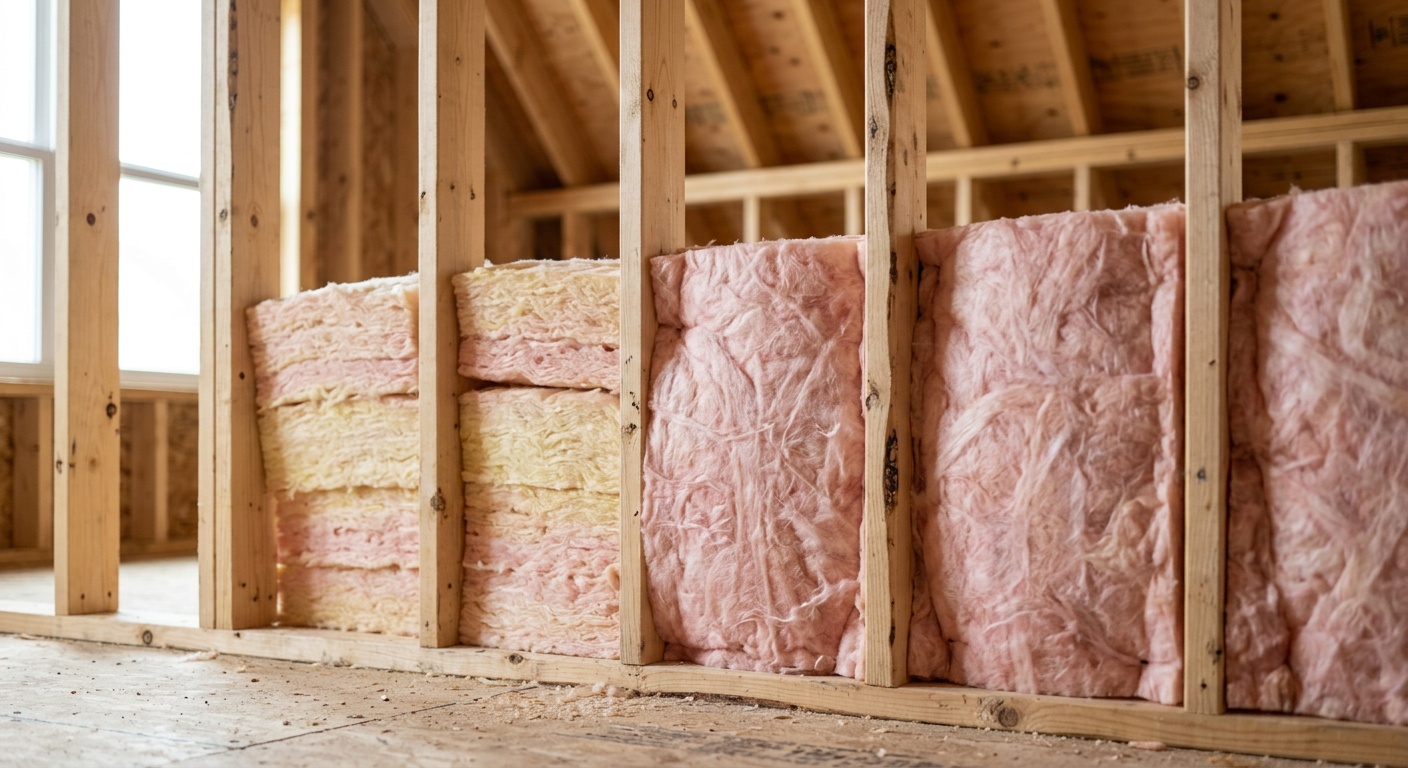
Fiberglass batts are the most widely installed insulation in North America — and for good reason. They’re affordable ($0.10 to $0.30 per square foot), widely available, and DIY-friendly. Standard batts offer R-2.9 to R-3.8 per inch, and high-density batts push R-4.3 per inch.
The honest limitation: fiberglass batts are highly susceptible to improper installation. Even small gaps around outlets, wiring, or framing members can reduce effective R-value by 30–50%. For small homes where precision matters, this installation sensitivity is a real risk. That said, when installed correctly — or combined with air sealing measures — fiberglass remains a solid, budget-conscious choice.
Best for: New construction with standard stud spacing; budget-conscious renovations
6. Aerogel Insulation Blankets
The 2026 newcomer worth knowing: aerogel insulation. Once confined to NASA spacecraft applications, aerogel blankets are now commercially available for residential use at increasingly accessible price points. With an extraordinary R-10 per inch, aerogel offers the highest thermal resistance of any commercially available insulation material.
For small homes with extremely limited wall or roof cavity space — think tiny homes, converted ADUs, or historic properties with strict thickness limitations — aerogel is a game-changer. The significant drawback remains cost: $4 to $10 per square foot, limiting it to high-priority thin-profile applications. But as production scales in 2026, prices are projected to drop 15–20% by 2027.
Best for: Thin-profile applications, historic homes, and tiny houses where space is at an absolute premium
Side-by-Side Comparison of Top Insulation Materials
| Material | R-Value/Inch | Cost/Sq Ft | DIY Friendly | Best Application |
|---|---|---|---|---|
| Spray Foam (Closed-Cell) | R-6 to R-7 | $1.50–$3.50 | ❌ No | Attic, crawl space, rim joists |
| Rigid Foam Board (Polyiso) | R-5.8 to R-6.5 | $0.25–$0.65 | ✅ Yes | Exterior walls, roof deck |
| Mineral Wool | R-3.0 to R-3.3 | $0.40–$1.50 | ✅ Yes | Walls, fire-sensitive areas |
| Cellulose (Blown-In) | R-3.2 to R-3.8 | $0.20–$0.50 | ⚠️ Partial | Attic floors, existing walls |
| Aerogel Blankets | R-10+ | $4.00–$10.00 | ✅ Yes | Thin-profile, tiny homes |
Real-World Case Studies
Case Study 1: The Phoenix Tiny Home Transformation
Meet Sarah and David Kowalski, owners of a 680-square-foot home in Phoenix, Arizona. In the brutal summer of 2025, their monthly cooling bill peaked at $380 — a figure that prompted serious action. Working with a building performance contractor, they implemented a two-phase insulation strategy:
Phase 1 (Attic): They replaced aging fiberglass batts with 4 inches of closed-cell spray foam directly applied to the underside of the roof deck, creating a conditioned attic space. Total cost: $2,800. Result: attic temperatures dropped from 145°F to 95°F on peak summer days.
Phase 2 (Exterior Walls): They added 2 inches of polyiso rigid foam board to the exterior, re-clad with fiber cement siding. Cost: $4,200. Combined impact: their summer cooling bills dropped to an average of $180/month — a 53% reduction. The full investment of approximately $7,000 is projected to pay off in 6.2 years.
Case Study 2: Historic Cottage Retrofit in Savannah, Georgia
When architect Maya Torres purchased a 750-square-foot 1920s cottage in Savannah in late 2025, she faced a common small-home dilemma: the home had 2×4 wall framing with almost no cavity depth, strict historic preservation requirements limiting exterior changes, and persistent humidity challenges.
Her solution was elegant: dense-pack cellulose blown into existing wall cavities through small drilled holes (patched and repainted afterward), combined with aerogel blankets installed behind new interior shiplap walls in two key south-facing rooms. The result was a 38% reduction in cooling load with no visible exterior alteration — critical for maintaining the cottage’s historic designation and keeping her eligible for Savannah’s heritage tax credits.
Insulation Performance Visualization: R-Value Per Dollar Efficiency
This chart shows the R-value per dollar invested (higher is better — more thermal resistance for your money):
9.2 pts
8.5 pts
7.2 pts
5.8 pts
3.8 pts
1.8 pts
* Score = Average R-value per inch ÷ average cost per square foot (normalized). Higher score = better value efficiency.
Common Challenges and How to Overcome Them
Challenge 1: Limited Space Means Limited Insulation Depth
Small homes often have shallower wall cavities — 2×4 framing with 3.5 inches of depth — compared to larger modern homes with 2×6 framing. This limits how much insulation you can pack into walls using conventional methods.
Solution: Prioritize high-R-per-inch materials like closed-cell spray foam or polyiso rigid foam. Alternatively, add continuous exterior insulation (rigid foam board or mineral wool panels) outside the existing wall assembly. This approach, known as “outsulation,” doesn’t sacrifice interior space and also eliminates thermal bridging through studs — a factor that can reduce effective wall R-value by up to 20% in standard framing.
Challenge 2: Air Leakage Undermining Insulation Performance
Many small homeowners invest in excellent insulation only to see disappointing energy savings — because air leakage was never addressed. According to the 2026 Residential Energy Efficiency Benchmark Study, the average existing small home leaks air equivalent to leaving a 1.5-square-foot hole open 24/7. Insulation without air sealing is like wearing a warm wool sweater with a wind tunnel running through it.
Solution: Before or during insulation installation, conduct a blower door test to identify specific leak locations. Seal attic bypasses, electrical penetrations, plumbing chases, and window/door frames with low-expansion spray foam or caulk. Studies consistently show that air sealing combined with insulation outperforms insulation alone by 25–40% in energy reduction.
Challenge 3: Balancing Budget Against Performance
The highest-performing materials (spray foam, aerogel) are also the most expensive. For small homeowners working with limited renovation budgets, this creates a real tension.
Solution: Adopt a zone-priority approach. Invest your highest-performance materials where they deliver the greatest thermal impact:
- Priority 1 — Attic/Roof: This is where you lose (or gain) the most heat. Spend here first.
- Priority 2 — Air Sealing: Cheap but high-impact; always do this before or with insulation.
- Priority 3 — Major Walls: Exterior-facing walls, especially south and west exposures.
- Priority 4 — Floors/Basement: Important but typically less thermally active than roofs and walls.
Also explore 2026 federal and state incentives. The extended Inflation Reduction Act provisions still provide a 30% tax credit (up to $1,200 annually) for insulation improvements in existing homes, with higher limits for heat pumps and comprehensive energy retrofits.
Frequently Asked Questions
What is the single most impactful insulation upgrade for a small home in a hot climate?
For small homes in hot climates, the attic is your number-one priority — by a significant margin. Up to 25–30% of summer heat gain enters through the roof and attic. Installing closed-cell spray foam directly to the underside of the roof deck (creating a “hot roof” assembly) or achieving R-49 to R-60 via blown cellulose or fiberglass on the attic floor will yield the most dramatic cooling load reduction. Pair this with radiant barrier foil if your attic currently lacks one — radiant barriers can reduce attic heat gain by an additional 25–40% in southern climates for a very modest investment.
Can I mix different insulation types in my small home?
Absolutely — and in many cases, hybrid insulation systems outperform single-material approaches. A common and highly effective combination is a “flash-and-batt” system: a thin layer (1–2 inches) of closed-cell spray foam is applied first to provide an air barrier and vapor control, then the remaining cavity is filled with mineral wool or fiberglass batts. This captures spray foam’s air-sealing excellence while using lower-cost batts for the bulk of thermal resistance. Similarly, combining exterior rigid foam with interior batt insulation eliminates thermal bridging while staying budget-conscious. Just ensure your building professional verifies the moisture dynamics of any hybrid assembly for your specific climate zone.
How do I know if my existing insulation needs replacing or can just be supplemented?
Start with a visual inspection: if existing fiberglass batts are compressed, stained with moisture, or visibly degraded, they’ve likely lost significant R-value and should be replaced. For less visible areas, a professional energy audit using an infrared thermal camera can reveal cold (or hot) spots in walls and ceilings with remarkable precision — these audits typically cost $200–$500 in 2026 and are often partially subsidized by utility companies. The key rule: never add new insulation on top of wet or moisture-damaged existing insulation. Address the moisture source first, replace damaged material, and then upgrade. Adding insulation over existing material in good condition (such as blown-in cellulose over existing attic fiberglass batts) is generally safe and effective.
Your Heat-Free Home: A Practical Action Roadmap
You’ve made it through the thermal deep-dive — now let’s convert this knowledge into momentum. Here’s your concrete next-steps roadmap:
- Schedule a professional energy audit (within 30 days). Before spending a dollar on materials, know exactly where your home is leaking energy. Request a blower door test and thermal imaging scan. Many utility companies offer these at reduced or no cost in 2026.
- Air seal before you insulate. Address the low-hanging fruit: caulk windows and doors, seal attic penetrations, insulate electrical outlets on exterior walls. This work often costs under $200 and compounds the value of every insulation dollar you spend afterward.
- Prioritize your attic with your best material. Based on your budget, choose closed-cell spray foam for maximum performance or dense-pack cellulose/blown fiberglass for value-focused results. Aim for R-49 minimum in IECC Climate Zones 4–8, R-38 in Zones 2–3.
- Explore 2026 federal and state incentives before purchasing. The 30% tax credit for insulation materials under current IRA provisions can significantly alter your material-choice math. Check the Database of State Incentives for Renewables and Efficiency (DSIRE) for your specific state’s additional programs.
- Track your results. Note pre- and post-improvement utility bills and monitor indoor temperature profiles. This data not only validates your investment but helps you make smart decisions about whether further upgrades (like an efficient mini-split heat pump) make sense for your home.
The broader implication here is significant: small homes are at the forefront of a global housing trend. With urban density increasing and ADU development booming across North America, optimized compact housing will define residential sustainability for the next generation. Getting your small home’s thermal envelope right isn’t just a personal win — it’s a contribution to a smarter, cooler built environment.
Your small home has an outsized opportunity. The proportional impact of smart insulation in a compact space is genuinely remarkable — and you’re now equipped with exactly the knowledge to capture it. So here’s the question worth sitting with: when the next heat wave hits, will your home be part of the problem, or your coolest competitive advantage?
Article reviewed by Mike O’Brien, Drywall Installation & Surface Finishing Specialist, on July 15, 2026