Room by room energy audit windows and insulation
Room by Room Energy Audit: Windows and Insulation Guide for 2026
Reading time: 14 minutes
Ever walked through your home in January and felt that telltale draft near the living room window? Or noticed your energy bills creeping up despite keeping the thermostat steady? You’re not imagining it — and you’re definitely not alone. In 2026, the average U.S. household spends $2,400 per year on energy costs, with heating and cooling accounting for nearly 45% of that total, according to the U.S. Department of Energy’s latest residential energy report.
Here’s the straight talk: most of that money is quietly escaping through poorly insulated walls, aging windows, and gaps you’ve probably walked past a hundred times without noticing. A room-by-room energy audit focused on windows and insulation is one of the most powerful investments you can make — not just for your wallet, but for your home’s long-term resilience and comfort.
This guide walks you through exactly how to do it, room by room, with the practical precision of a professional energy auditor and the clarity of a conversation with a trusted friend.
Table of Contents
- Why a Room-by-Room Approach Beats a Whole-House Guess
- Essential Tools Before You Begin
- Living Areas: Where Comfort Meets Energy Loss
- Bedrooms: The Overnight Drain
- Kitchen and Bathrooms: Hidden Humidity and Heat Loss
- Attic and Basement: Your Home’s Thermal Anchors
- Windows Deep Dive: Ratings, Replacements, and Retrofits
- Insulation Types Compared
- Energy Loss by Room: A Visual Breakdown
- Frequently Asked Questions
- Your Home Efficiency Roadmap: Next Steps
Why a Room-by-Room Approach Beats a Whole-House Guess
Most homeowners make the mistake of thinking about energy efficiency as a single, monolithic problem — “my house is drafty,” or “my bills are high.” But your home is actually a collection of microclimates, each with its own unique vulnerabilities. A bedroom on the north-facing wall of your house behaves very differently from a south-facing sunroom, and a basement with exposed concrete walls is a completely different challenge from an insulated garage.
When you audit room by room, you accomplish three things simultaneously:
- Identify the highest-priority fixes — so you spend money where it matters most
- Build a sequential upgrade path — rather than overwhelming yourself with a full renovation
- Track your progress accurately — by comparing before-and-after energy performance per zone
Consider the case of the Martínez family in Phoenix, Arizona. In 2025, they hired a certified energy auditor who identified that their master bedroom — a 2003 addition to the original house — had R-11 insulation in walls that should have been R-19 for the Arizona climate zone. Meanwhile, their living room windows, though older, were actually double-paned and performing adequately. By focusing only on the bedroom addition and adding spray foam insulation to its rim joists, they cut their summer cooling bill by 18% without replacing a single window.
Pro Tip: Don’t assume your oldest room is your worst performer. New additions and finished basements are frequently the biggest culprits because they were built or renovated under different code requirements.
Essential Tools Before You Begin
You don’t need to be a certified building scientist to conduct a meaningful room-by-room audit. But having the right tools transforms guesswork into data. Here’s what to gather:
- Infrared thermometer or thermal camera — Entry-level thermal cameras now cost under $200 in 2026 and connect directly to your smartphone. Brands like FLIR and Seek Thermal offer consumer models that reveal cold spots behind walls and around window frames instantly.
- Draft detector or smoke pencil — A simple incense stick works surprisingly well for tracing air leaks near window seals and baseboards.
- Moisture meter — Critical for detecting condensation-related insulation degradation, especially in bathrooms and basements.
- Tape measure and notepad — For recording window dimensions, noting visible gaps, and documenting findings room by room.
- Flashlight — Essential for attic inspections where lighting is minimal.
If you want professional-grade results, consider scheduling a blower door test with a certified energy auditor. This pressurization test quantifies your home’s total air leakage and pinpoints exactly where infiltration is occurring. In 2026, many utility companies offer subsidized or free blower door tests as part of their energy efficiency incentive programs — check your provider’s website before spending a dime.
Living Areas: Where Comfort Meets Energy Loss
Auditing Your Windows in Living Rooms and Common Spaces
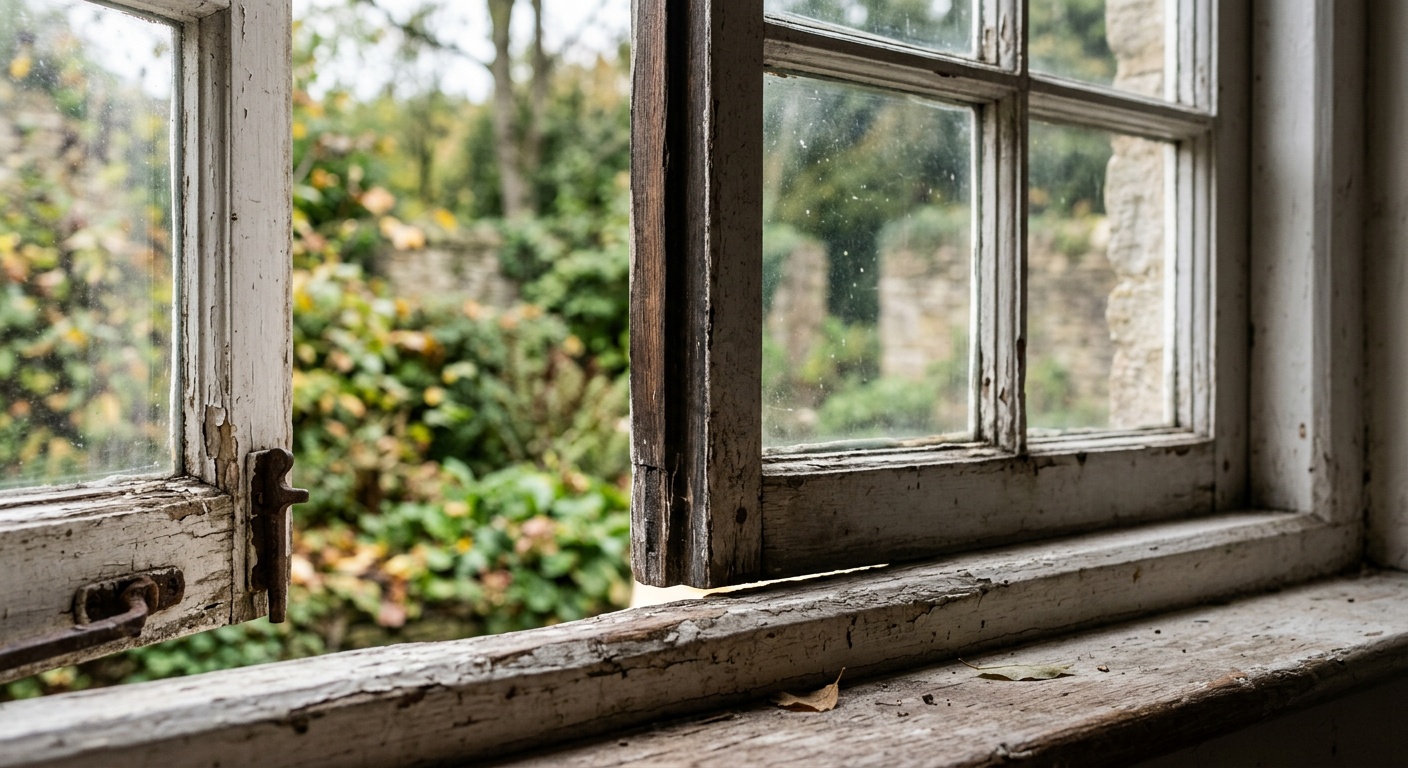
Living rooms typically have the largest window surfaces in the home, making them a priority during any energy audit. Start by standing close to each window on a cold morning and feeling for temperature differentials with your palm — you shouldn’t feel noticeably cold air radiating from the glass more than a few inches away.
Check these specific items:
- Window frame condition — Cracked, warped, or peeling frames indicate seal failure and likely air infiltration
- Condensation between panes — On double or triple-pane windows, fogging between the glass layers means the inert gas fill (argon or krypton) has escaped, dramatically reducing thermal performance
- Weatherstripping integrity — Compress the weatherstripping around operable windows. If it doesn’t spring back, it’s no longer sealing effectively
- Caulking at wall junctions — Run your finger along the interior perimeter where the window trim meets the wall. Any gaps here create direct pathways for conditioned air to escape
Insulation Assessment in Living Spaces
In living areas, your primary insulation concern is the exterior walls and any wall shared with an unconditioned space like a garage. If your home was built before 1980, there’s a real possibility that wall cavities have little to no insulation — especially if you’ve never had a retrofit done.
A quick test: remove an outlet cover plate on an exterior wall. Behind the plastic ring, you can often see directly into the wall cavity. Shine a flashlight in — you should see insulation filling the space. If you see bare wood studs with empty space behind them, that wall is uninsulated and needs attention.
Important note for 2026 homeowners: The Inflation Reduction Act’s extended efficiency tax credits remain available through 2032, offering up to 30% back (capped at $1,200 per year) for insulation improvements and energy-efficient window upgrades. Living room window replacements with qualifying ENERGY STAR ratings are fully eligible.
Bedrooms: The Overnight Drain
We spend roughly a third of our lives in bedrooms, yet these rooms are frequently under-audited. The key vulnerability here is often the exterior wall behind the headboard — particularly in older homes where corner bedrooms expose two exterior walls with potentially minimal insulation.
During your bedroom audit, pay close attention to:
- Corner wall intersections — These are notoriously difficult to insulate properly during original construction and often have cold bridging through wood framing
- Window sill areas — Cold air pooling at window sills drops to the floor and creates the uncomfortable “cold feet” sensation even with the room at 70°F
- Electrical outlets on exterior walls — Each outlet box is a small but real penetration through your insulation and vapor barrier
- Ceiling-to-wall junction — In rooms directly below the attic, this junction is a major air leakage point if attic insulation doesn’t fully extend to the eaves
A quick scenario worth considering: imagine a child’s bedroom on the northeast corner of a two-story home. Even with the thermostat set at 68°F, the child wakes up cold. A thermal camera reveals that two exterior walls have insulation voids — areas where batt insulation was improperly installed and has sagged away from the drywall over 15 years. The fix? Blown-in insulation injected through small holes drilled from the exterior, patched and repainted after. Cost in 2026: approximately $600–$900 for a standard bedroom. Result: a measurable 4°F improvement in mean radiant temperature during winter nights.
Kitchen and Bathrooms: Hidden Humidity and Heat Loss
These rooms present a unique dual challenge: they generate moisture that can degrade insulation performance over time, and they often have penetrations — exhaust fans, plumbing vents, recessed lighting — that create direct air pathways between conditioned and unconditioned spaces.
Focus your audit here on:
- Exhaust fan duct integrity — Many bathroom exhaust fans duct directly into the attic rather than through the roof. This is a code violation in most jurisdictions, but it’s shockingly common in homes built before 2000. Moist air deposited in your attic degrades insulation and creates mold conditions.
- Under-sink cabinet exterior walls — The wall behind the plumbing under kitchen and bathroom sinks is frequently the coldest spot in the room because pipes were plumbed through the insulation, displacing it.
- Recessed lighting fixtures — Older “IC-rated” can lights in ceilings below unconditioned attic space are still significant air leakage points. Modern air-tight LED retrofit kits can seal these completely.
- Window condensation patterns — Chronic condensation on bathroom windows doesn’t just indicate a ventilation problem; it suggests the window is consistently cold enough to reach dew point, meaning its thermal resistance is inadequate.
Attic and Basement: Your Home’s Thermal Anchors
If living rooms and bedrooms are where you feel energy problems, the attic and basement are where those problems are caused. These two spaces account for the majority of heat transfer in a typical home.
According to ENERGY STAR’s 2025 residential data, attic insulation upgrades deliver an average annual savings of $200–$600 for homes in climate zones 3 through 7, with higher savings in colder climates. The EPA recommends R-38 to R-60 for most U.S. attics, yet millions of homes still have R-19 or less.
In your attic, check:
- Current insulation depth and type (blown cellulose, fiberglass batts, spray foam)
- Whether insulation extends fully to the eaves without blocking soffit vents
- Air sealing at the attic hatch — one of the most commonly neglected heat loss points
- Condition of any skylight curbs or dormers (these are frequently under-insulated)
In basements and crawlspaces, the primary concern shifts from heat loss to moisture management. Rigid foam board insulation on foundation walls combined with a proper vapor barrier is the modern standard. If you have an older home with fiberglass batts against basement walls, replace them — they absorb moisture and provide ideal conditions for mold growth.
Windows Deep Dive: Ratings, Replacements, and Retrofits
Understanding Window Performance Ratings
Not all windows are created equal, and the NFRC (National Fenestration Rating Council) label is your guide. In 2026, look for these key metrics when evaluating existing windows or shopping for replacements:
- U-Factor — Measures heat transfer rate. Lower is better. ENERGY STAR requires ≤0.27 for northern climate zones.
- Solar Heat Gain Coefficient (SHGC) — How much solar radiation passes through. Lower SHGC reduces cooling loads in hot climates; higher SHGC is beneficial in cold climates for passive solar gain.
- Air Leakage (AL) — Rated in cubic feet per minute per square foot. Look for AL ≤ 0.30.
- Visible Transmittance (VT) — How much visible light passes through. Higher VT = more natural light.
When to Repair vs. Replace
Window replacement is expensive — averaging $400–$1,000 per window in 2026 depending on size, style, and glazing type. Before committing to full replacement, consider whether repairs can restore meaningful performance:
- Replace weatherstripping and re-caulk if the frame is structurally sound — cost: $10–$50 per window, restores 60–80% of air infiltration performance
- Add interior window insulation film — 3M and other manufacturers offer low-e film that can improve U-factor by 20–30%
- Install interior storm windows — Indow and similar brands offer custom interior acrylic panels that achieve near triple-pane performance without exterior modifications
- Replace only failed sealed units — If fog between panes is your only issue, the insulated glass unit (IGU) can often be replaced without touching the frame, at roughly 30–50% of full window replacement cost
Insulation Types Compared
Choosing the right insulation type for each room is as important as the quantity installed. Here’s a focused comparison of the most relevant options for 2026 residential retrofits:
| Insulation Type | R-Value per Inch | Best Application | Avg. Cost/sq.ft (2026) | Air Sealing Capability |
|---|---|---|---|---|
| Spray Foam (Closed Cell) | R-6 to R-7 | Rim joists, crawlspaces | $1.50 – $3.00 | Excellent |
| Blown Cellulose | R-3.2 to R-3.8 | Attics, existing walls | $0.60 – $1.20 | Moderate |
| Fiberglass Batts | R-2.9 to R-3.8 | New wall framing, floors | $0.30 – $0.70 | Poor (requires separate sealing) |
| Rigid Foam Board (XPS) | R-5 per inch | Basement walls, exterior sheathing | $0.80 – $1.50 | Good when seams taped |
| Mineral Wool (Rockwool) | R-3.0 to R-4.2 | Walls, fire-rated assemblies | $0.80 – $1.60 | Moderate |
Key insight for 2026: Closed-cell spray foam remains the gold standard for air sealing despite its higher cost. When applied at the rim joist and around penetrations, even a 2-inch application ($1–$2 per linear foot) can reduce total home air leakage by 25–40% on its own.
Energy Loss by Room: A Visual Breakdown
Where is your home actually losing the most energy? This visualization, based on aggregated data from the Lawrence Berkeley National Laboratory’s 2025 residential building stock analysis, shows typical percentage contributions to total home heat loss:
Typical Heat Loss Distribution in Pre-2000 U.S. Homes
38%
25%
18%
12%
7%
This data underscores why the attic and windows are the highest-priority targets in any energy audit. Together, they account for 63% of typical heat loss — and both are highly addressable through retrofit work without major renovation.
Common Challenges and How to Overcome Them
Challenge 1: Old Homes with Plaster Walls
Homes built before 1950 often have thick plaster walls that are beautiful but challenging to retrofit insulate. Drilling through exterior cladding for blown-in insulation requires careful planning to avoid damaging historic finishes. The recommended approach in 2026 is to work with a contractor who uses dense-pack cellulose through carefully positioned exterior holes in the siding, filled and repainted afterward. Interior approaches — adding rigid foam behind new drywall — are also viable but reduce room dimensions slightly.
Challenge 2: Vapor Barriers in Mixed Climates
If you live in a mixed-humid climate zone (IECC zones 3 or 4), vapor barrier placement is genuinely complicated. Installing a vapor barrier (plastic sheeting) on the wrong side of the insulation assembly can actually trap moisture and cause structural damage. The modern guidance — reflected in the 2024 IRC code adopted by most states — is to use vapor retarders rather than full barriers, and to focus on air sealing rather than vapor control. When in doubt, consult a building science professional before installing new insulation in mixed climates.
Challenge 3: Balancing Ventilation with Air Tightness
One of the most misunderstood concepts in home energy efficiency is this: you can make a home too tight without adding mechanical ventilation, leading to indoor air quality problems. As you air-seal and insulate, you need to ensure fresh air exchange happens intentionally — through an HRV (Heat Recovery Ventilator) or ERV (Energy Recovery Ventilator) — rather than accidentally through gaps and cracks. In 2026, these systems are eligible for the 25C tax credit under the Inflation Reduction Act, making the upgrade financially accessible for most homeowners.
Frequently Asked Questions
How do I know if my windows need replacing or just better weatherstripping?
Start with the glass itself: if you see fogging or condensation permanently trapped between panes, the sealed unit has failed and thermal performance is compromised — replacement is warranted. If the glass is clear but you feel drafts, check weatherstripping and caulking first. Replacing weatherstripping ($10–$30 per window) and re-caulking ($5–$15 per window) often restores 70–80% of an operable window’s air sealing performance. Reserve full replacement for windows with failed seals, cracked frames, or single-pane glazing in cold climates where U-factor is significantly above 0.35.
What R-value should I target for attic insulation in 2026?
The Department of Energy’s current recommendation ranges from R-38 to R-60 depending on your climate zone. For climate zones 1–2 (southern Florida, Hawaii), R-38 is typically sufficient. Zones 3–4 (most of the Southeast and Mid-Atlantic) should aim for R-49. Zones 5–8 (Midwest through northern New England and Alaska) should target R-60. Many older homes have R-19 or less, meaning doubling or tripling attic insulation depth is often the single highest-ROI energy upgrade available — with payback periods of 3–7 years in most climates.
Are energy audits worth the cost for average homeowners?
Absolutely — especially in 2026 when many utility companies and state energy offices provide rebates or free professional audits. A certified Home Energy Rating System (HERS) audit typically costs $300–$600 when paid out of pocket, but it provides a prioritized, data-driven upgrade roadmap that prevents thousands of dollars in misdirected spending. Homeowners who follow audit recommendations typically recover audit costs within the first year of energy savings. Even a DIY audit following the room-by-room framework in this guide can identify quick wins — weatherstripping, caulking, attic hatch insulation — that pay for themselves within weeks.
Your Home Efficiency Roadmap: Turning Knowledge Into Action
You’ve now got a room-by-room lens for understanding where your home’s energy is going — and more importantly, how to stop the losses. Here’s your practical action plan for 2026 and beyond:
- This weekend (free): Walk through every room with an incense stick or thermal camera app. Document drafts, check weatherstripping, and look for condensation on windows. Photograph everything.
- Within 30 days (under $200): Replace failed weatherstripping, re-caulk window perimeters, insulate your attic hatch, and seal any visible electrical penetrations on exterior walls with fire-rated caulk.
- Within 90 days: Schedule a blower door test or professional energy audit, check your utility provider for rebates, and get quotes for attic insulation upgrades if your current depth is below the recommended R-value for your climate zone.
- Within 12 months: Prioritize any window replacements identified as having failed seals. Budget for basement rim joist spray foam if not already done. Research HRV/ERV systems if you’re doing significant air sealing work.
- By 2027: Reassess your HERS score or utility bills annually to verify savings and identify any remaining opportunities — especially before adding a heat pump or solar system, which perform dramatically better in a well-sealed, well-insulated home.
The broader trend here matters: building energy codes are tightening globally, and homes that meet or exceed 2026 standards will carry measurably higher resale values as buyers increasingly factor operating costs into purchase decisions. A properly audited and upgraded home isn’t just more comfortable today — it’s a more valuable, more resilient asset for tomorrow.
Here’s a question worth sitting with: If your home’s windows and insulation are quietly costing you $80–$150 per month in unnecessary energy bills, how many years have you already let that money walk out the door — and what’s your plan to stop it this year?
The audit starts with one room. Pick the one you’ve always suspected is the problem, grab a candle or thermal camera, and find out what your house has been trying to tell you all along.
Article reviewed by Mike O’Brien, Drywall Installation & Surface Finishing Specialist, on June 8, 2026