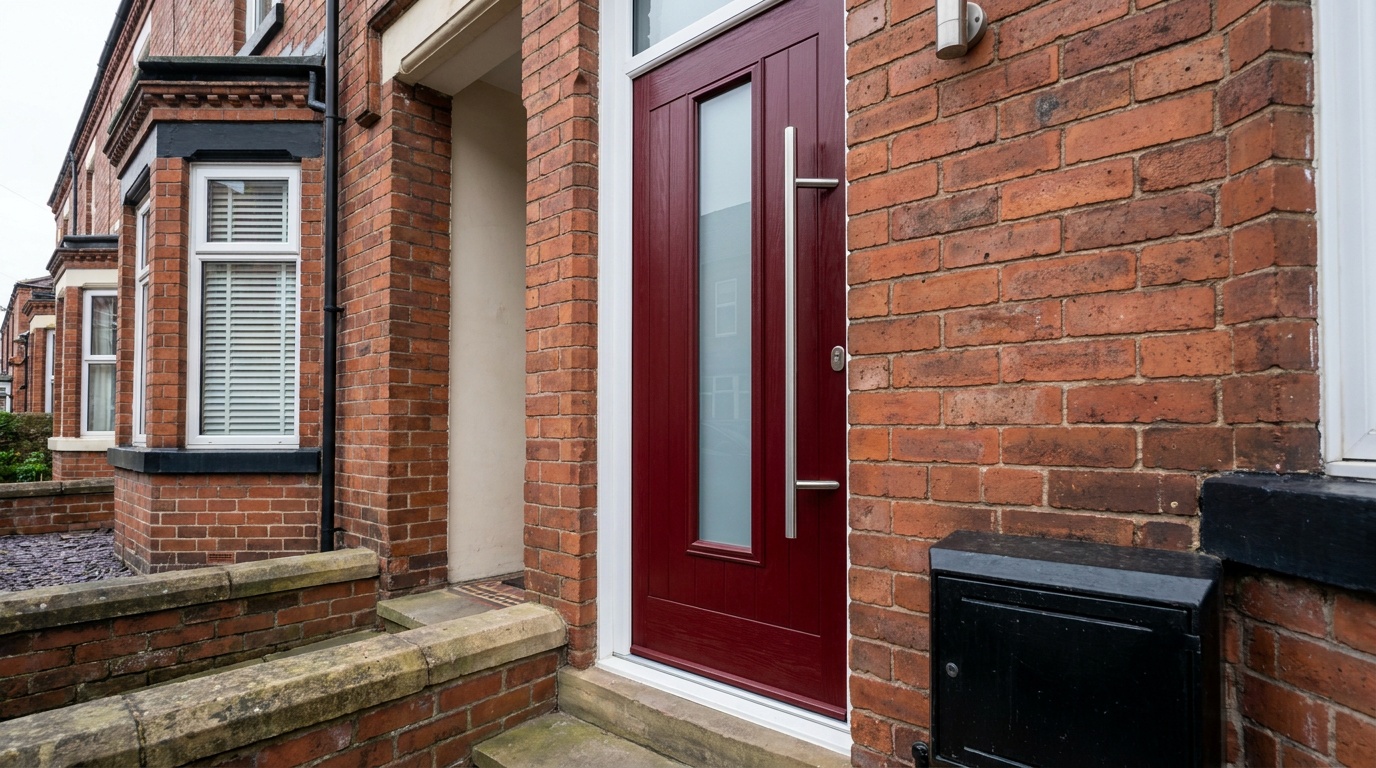
Composite Front Doors: Security Ratings and Modern Styles for UK Homes
Composite Front Doors: Security Ratings and Modern Styles for UK Homes
Reading time: 12 minutes
Your front door is the first line of defence and the first impression your home makes on the world. Yet thousands of UK homeowners are still relying on outdated timber or uPVC doors that fall short on both security and kerb appeal. If you’ve ever wondered whether a composite front door is worth the investment — or felt overwhelmed by the sheer variety of styles, ratings, and jargon — you’re in good company.
Here’s the straight talk: choosing the right composite door in 2026 isn’t just about aesthetics. It’s about understanding security certifications, thermal performance, and long-term value — and making a decision that protects your family and your property for decades to come.
Table of Contents
- What Is a Composite Front Door?
- Understanding Security Ratings
- Modern Styles for UK Homes in 2026
- Thermal Performance and Energy Efficiency
- Composite vs. Other Door Types
- Common Challenges and How to Overcome Them
- FAQs
- Your Composite Door Decision: A Practical Roadmap
What Is a Composite Front Door?
A composite front door is precisely what it sounds like: a door engineered from multiple materials, each chosen for a specific performance characteristic. Unlike a solid timber door (which can warp and swell) or a hollow uPVC door (which may lack rigidity), a composite door combines the best properties of several materials into one robust structure.
The Anatomy of a Composite Door
Understanding what goes into your door helps you evaluate quality claims and compare products meaningfully. Here’s what a high-quality composite door typically contains:
- Outer skin: Usually a Glass Reinforced Plastic (GRP) or Sheet Moulding Compound (SMC) surface, which is durable, weather-resistant, and can mimic the grain of timber with impressive realism.
- Inner core: A high-density polyurethane foam core, typically 70mm–100mm thick, offering exceptional thermal insulation and structural rigidity.
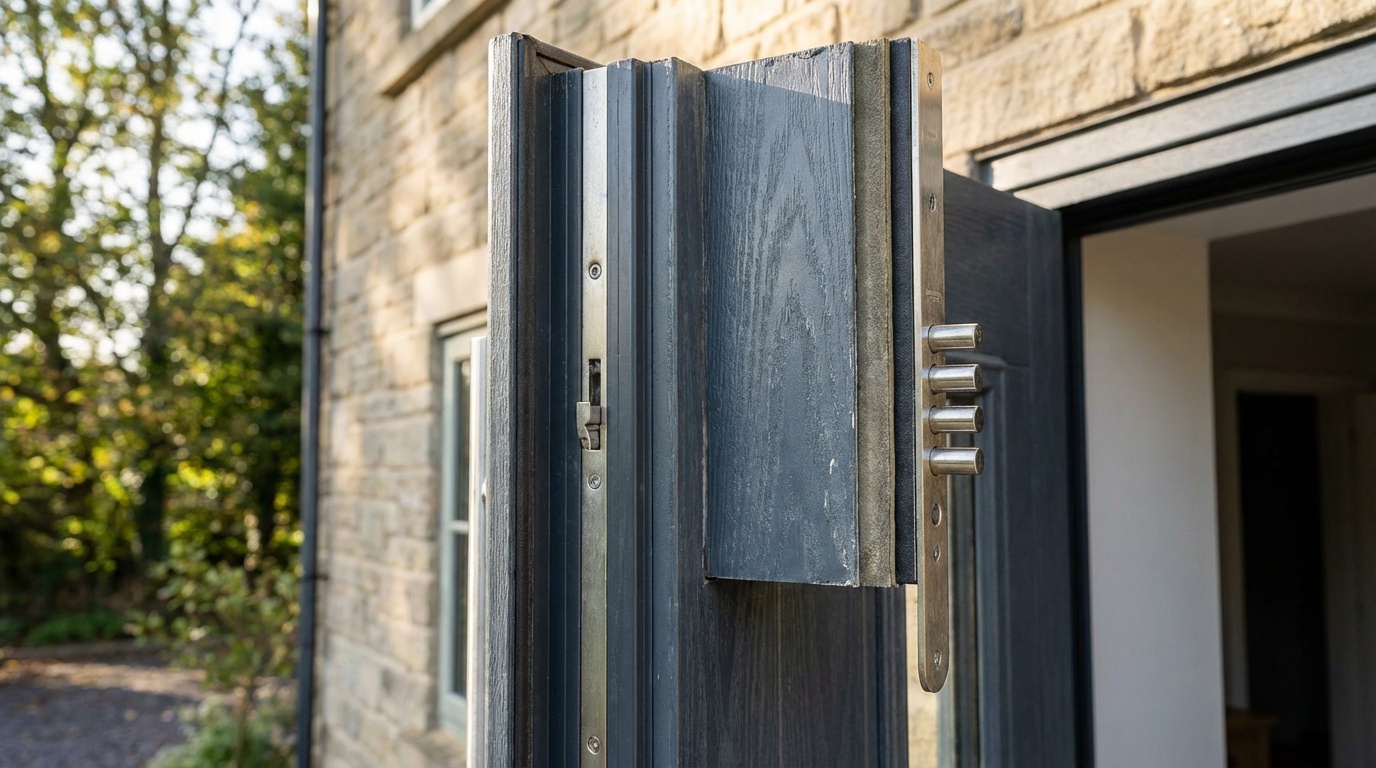
- Reinforced frame: A uPVC or timber subframe is embedded within the door, providing the rigid skeleton that holds everything together and anchors the locking mechanism.
- Outer frame: The surrounding door frame is usually a multipoint-locking-compatible uPVC or aluminium profile, depending on the system chosen.
- Weatherseals: Compression or bubble seals around the perimeter prevent draughts, water ingress, and noise — critical for UK weather conditions.
According to the Door & Hardware Federation (DHF), composite doors now account for approximately 62% of all residential front door installations in the UK as of 2026 — a figure that has grown steadily from around 45% in 2019. That growth reflects a genuine shift in how homeowners prioritise security, insulation, and low-maintenance living.
Why UK Homeowners Are Choosing Composite
Consider the experience of Sarah and James, a couple in Sheffield who replaced their original 1980s timber door in late 2025. Their old door had swollen so badly over one particularly wet autumn that they struggled to close it properly — a common issue with untreated timber. After installing a 44mm composite door with a PAS 24:2022-certified multipoint lock, they noticed an immediate difference in draught reduction and reported a £180 annual saving on heating bills based on their January 2026 energy comparison. Their home insurance provider also offered a 7% premium discount after confirming the door’s security certification — a tangible financial benefit that many homeowners overlook entirely.
Understanding Security Ratings
Security ratings are the most critical — and most misunderstood — aspect of composite door selection. If you’re spending £1,000–£3,000 on a new front door, you need to know exactly what level of protection you’re getting, and why the certification numbers actually matter.
The Key UK Security Standards Explained
PAS 24:2022 — Published by the British Standards Institution (BSI), PAS 24 (Publicly Available Specification 24) is the baseline security standard for enhanced security performance of door assemblies in the UK. The 2022 revision tightened testing protocols significantly, requiring doors to resist physical attack for a minimum sustained period while also resisting manipulation attacks on hardware. Any door being installed under Part Q of the Building Regulations (which applies to new-build properties and conversions) must meet PAS 24 as a minimum.
SBD (Secured by Design) — Secured by Design is the official UK Police Crime Prevention Initiative. When a composite door carries the SBD accreditation, it means it has been independently tested and approved by the police’s own security experts. In 2026, SBD-accredited products must meet PAS 24:2022 as a minimum, but many go beyond this. Research published by the College of Policing found that homes fitted with SBD-compliant products experience up to 75% fewer break-ins compared to homes with standard products.
Document Q (Part Q) — This is the section of the UK Building Regulations that specifically governs security in new dwellings. If your property falls under its scope, your door installer is legally obliged to fit a door that meets the Document Q requirements. Composite doors from reputable manufacturers are routinely tested to exceed these requirements.
RC2 / EN 1627 — This is the European resistance class standard, and it’s worth understanding even in the UK post-Brexit context because many premium door manufacturers use it as a benchmark. RC2 (Resistance Class 2) means the door can resist a competent burglar using basic tools — jemmies, screwdrivers, wedges — for a minimum of three minutes. RC3 goes further, resisting experienced attackers with a more extensive toolkit for five minutes. For most UK residential properties, RC2 is the appropriate target.
TS007 3-Star Rating — This standard applies specifically to door cylinders (the lock barrel). Many composite door packages include a 3-star TS007 cylinder, which provides resistance against snapping, picking, bumping, and drilling — the four most common methods of cylinder attack used by burglars. A door with an SBD-certified frame but a standard cylinder is only as strong as its weakest component.
“The biggest mistake homeowners make is buying a well-rated door and then fitting a cheap cylinder. You’ve essentially built a reinforced wall with a cardboard gate.” — Mark Tierney, Security Consultant and DHF Training Partner, speaking at the 2025 UK Fenestration Summit
Modern Styles for UK Homes in 2026
The good news for design-conscious homeowners is that security and style are no longer in tension. The composite door market in 2026 offers an astonishing breadth of aesthetic options — from deeply traditional panelled designs to crisp contemporary glazed panels. Here’s how to navigate the style landscape intelligently.
The Four Dominant Style Categories
1. Traditional and Heritage Styles — These doors feature raised and fielded panels, often mimicking Victorian or Edwardian timber joinery. Popular in period terraces across cities like London, Manchester, and Leeds, they come in deep, rich colours: Chartwell Green, Slate Blue, and Farrow & Ball-inspired hues are particularly in demand in 2026. GRP skins on these doors achieve a remarkably convincing timber grain texture, something that would have seemed impossible a decade ago.
2. Contemporary and Minimalist Styles — Flush composite doors with minimal panel lines, strong geometric glazing inserts, and bold colour choices (including matt black, anthracite grey, and even dual-tone options with contrasting inner and outer colours) have surged in popularity. These work exceptionally well with newer-build properties and extended or renovated homes with modern architectural detailing.
3. Glazed and Part-Glazed Styles — Whether it’s a full-length side panel, a decorative leaded glass insert, or a large clear glazed section for light flooding into a hallway, glazed composite doors are enormously versatile. It’s worth noting that glazing units in high-quality composite doors must comply with Part Q as well — laminated or toughened glass and secure beading are non-negotiable from a security standpoint.
4. Cottage and Rural Styles — Stable-style doors, rounded arch tops, and farmhouse panel configurations suit period rural and semi-rural properties. In 2026, these remain a staple for properties in Cotswolds villages, Yorkshire Dales market towns, and Scottish rural communities where planners often restrict dramatic departures from the vernacular aesthetic.
Colour Trends for 2026
Industry data from composite door manufacturers Solidor, Rockdoor, and Endurance Doors suggests the following colour trends are dominating UK orders in 2026:
- Anthracite Grey — Consistently the top-selling colour for the fourth consecutive year, particularly in contemporary and flush styles.
- Chartwell Green — A sophisticated sage-influenced green that’s seen a 34% increase in orders year-on-year, reflecting broader interior design colour trends.
- Matt Black — Urban and bold, particularly popular in London and Birmingham for contemporary extensions and renovated Victorian terraces.
- Slate Blue — A cooler, more nuanced alternative to traditional navy, seeing strong uptake in Scottish and Northern English markets.
- Cream and Pebble — Enduringly popular for traditional styles, especially in rural and coastal settings across the South West and East Anglia.
An important practical point: composite GRP skins hold colour exceptionally well, but darker colours (particularly matt black and very dark greys) can absorb heat in direct sunlight and, in extreme cases, cause very minor surface flex. Choose a door with a UV-stabilised coating and check the manufacturer’s warranty on colour retention — reputable brands offer 10-year colour guarantees as standard in 2026.
Thermal Performance and Energy Efficiency
In 2026, with UK energy prices still elevated compared to pre-2021 levels and the government’s updated Future Homes Standard coming into full effect, thermal performance is no longer a secondary consideration for composite door buyers — it’s a primary one.
Doors are measured for thermal performance using a U-value, expressed in W/m²K. The lower the number, the better the insulation. Here’s how composite doors compare against thresholds:
- Building Regulations minimum (Part L, England): 1.4 W/m²K for replacement doors
- Standard composite door (70mm core): approximately 1.2–1.4 W/m²K
- Premium composite door (100mm core): approximately 0.8–1.1 W/m²K
- Passive House standard target: 0.8 W/m²K or below
The polyurethane foam core in a composite door provides insulation values far superior to hollow-panel uPVC or even solid timber. For a three-bedroom semi-detached home, upgrading from a single-glazed timber door to a premium composite with a low U-value can save an estimated £120–£200 per year on heating costs, depending on your boiler type and heating habits.
Composite vs. Other Door Types: The Essential Comparison
Before committing to composite, it’s worth understanding how it stacks up against the alternatives. Use the table below to make a direct, informed comparison.
| Feature | Composite | Solid Timber | uPVC | Aluminium |
|---|---|---|---|---|
| Security Rating | PAS 24 / SBD standard | Variable (lock-dependent) | PAS 24 (quality brands) | RC2/RC3 achievable |
| Thermal U-Value | 0.8–1.4 W/m²K | 2.0–3.0 W/m²K | 1.2–1.8 W/m²K | 1.0–1.6 W/m²K |
| Maintenance Level | Very low (wipe clean) | High (annual treatment) | Low | Very low |
| Typical Cost (supply & fit) | £1,000–£3,000 | £1,500–£5,000+ | £600–£1,500 | £2,000–£5,000+ |
| Lifespan | 35+ years | 20–40 years (with care) | 20–25 years | 45+ years |
The data makes a compelling case: composite doors strike an optimal balance between security, thermal efficiency, maintenance demands, and cost. While aluminium doors may offer superior longevity and aluminium’s minimalist aesthetic suits ultra-modern properties, the price premium places them out of reach for many homeowners. Composite genuinely hits the sweet spot for the majority of UK residential applications.
Security Performance at a Glance
Here’s a visual comparison of security performance ratings across door types, based on industry testing averages in 2026:
Security Performance Score (out of 100)
88
82
72
61
48
Scores represent a composite index of physical attack resistance, lock quality, frame rigidity, and certification level. Source: Door Industry benchmarking analysis, 2026.
Common Challenges and How to Overcome Them
Even the best composite door purchase can go wrong if you don’t anticipate the common pitfalls. Here are three challenges homeowners frequently encounter — and exactly how to navigate them.
Challenge 1: Choosing a Door That Doesn’t Meet Planning Restrictions
If you live in a Conservation Area, a Listed Building, or under an Article 4 Direction, your choice of front door may be significantly restricted by your local planning authority. In 2026, with councils increasingly scrutinising material changes to street-facing elevations, this catches homeowners off guard more often than you’d expect.
How to overcome it: Contact your local council’s planning department before you order anything. For Conservation Areas, the key question is whether your replacement door is of a “like-for-like” character with the original. Many high-quality composite doors with realistic GRP timber-grain finishes have been approved in Conservation Areas — but you need written confirmation before you proceed. Ask your installer whether they have experience with Conservation Area installations and whether they can provide examples of approved projects in similar settings.
Challenge 2: Misunderstanding What “Security Rated” Actually Means
This is arguably the most common and costly mistake. A door marketed as “security rated” or even “PAS 24 compliant” in a brochure is not the same as a complete door set — including frame, hinges, cylinder, and hardware — that has been independently tested and certified as a whole assembly.
How to overcome it: Always ask for the specific test certificate or Secured by Design product listing reference. Genuine SBD-accredited composite door sets are listed on the official SBD website (securedbydesign.com), which is publicly searchable. Check the product name and manufacturer reference against the live database before signing a contract. If a supplier can’t provide this, treat it as a red flag.
Challenge 3: Warping, Dropping, and Long-Term Fitting Issues
While composite doors are significantly more stable than timber, they’re not entirely immune to issues. A door that’s installed with inadequate frame support, or a GRP skin that’s exposed to extreme direct sunlight without a UV-protective coating, can develop minor flex or the door can drop on its hinges over time. This can cause alignment issues with multipoint locking mechanisms, making the door difficult to lock or unlock.
How to overcome it: Insist on a manufacturer’s guarantee of at least 10 years on the door itself, and ensure the installer provides a minimum 2-year installation guarantee. Check that the hinges are heavy-duty, stainless steel, and rated for the door’s weight — a 44mm composite door can weigh 60–80kg, and cheap hinges will struggle. Ask specifically whether the manufacturer offers an anti-warp guarantee, which leading brands like Rockdoor, Endurance, and Solidor do include as standard.
Frequently Asked Questions
Are composite front doors suitable for all types of UK properties, including period homes?
Yes, in most cases. The GRP skins available on modern composite doors are manufactured with exceptional detail, replicating the texture and grain of timber so convincingly that they satisfy the aesthetic requirements of many period properties. However, if your property is in a Conservation Area or is Listed, you must consult your local planning authority before proceeding. Many councils have approved composite doors in Conservation Areas where the design and colour are sympathetic to the surrounding streetscape. Always get any approval in writing before installation begins, and use an installer experienced in heritage property compliance.
How do I verify that a composite door genuinely meets PAS 24:2022 or Secured by Design standards?
The most reliable method is to search the Secured by Design product database at securedbydesign.com using the manufacturer name and product line. SBD only lists products that have passed independent testing as complete door sets — including frame, hardware, and lock — so a listing there provides genuine assurance. Additionally, ask your supplier for the actual BSI test certificate number (not just a marketing claim) and verify it with the testing body if you want absolute certainty. Reputable manufacturers — Rockdoor, Solidor, Endurance, and Composite Prime among them — will provide this documentation without hesitation.
What is a realistic budget for a quality, security-rated composite front door in 2026?
For a supply-and-fit composite door with PAS 24:2022 certification, a TS007 3-star cylinder, and a 10-year manufacturer guarantee, budget between £1,400 and £2,200 for a single door without sidelights. Doors with glazed sidelights or top panels, premium hardware, or additional glazing features typically range from £2,000 to £3,000+. Be cautious of quotes significantly below £1,200 supply-and-fit — at that price point, compromises are almost always being made on cylinder quality, hinge specification, or the door core itself. Consider this an investment: a quality composite door can add £3,000–£5,000 to a property’s perceived value and may reduce your home insurance premium.
Your Composite Door Decision: A Practical Roadmap
You’ve now got the essential knowledge to make a genuinely informed composite door decision. Here’s how to turn that knowledge into action, step by step:
- Establish your planning position first. Before you look at a single brochure, confirm whether your property is in a Conservation Area or subject to Article 4 restrictions. Contact your local council’s planning department — it’s free and takes one phone call or email.
- Define your security requirements. If you’re replacing a door in a new-build or conversion, Part Q compliance (which requires PAS 24 as minimum) may be mandatory. For existing properties, aim for PAS 24:2022 and SBD accreditation as a minimum. Consider RC2 (EN 1627) if your insurer or personal risk assessment calls for it.
- Select your style and specification. Choose a style suited to your property’s architecture, then specify: door thickness (aim for 44mm minimum), U-value (target below 1.2 W/m²K), cylinder star rating (3-star TS007), and hardware finish.
- Vet your installer rigorously. Choose a FENSA or CERTASS registered installer. These schemes ensure compliance with Building Regulations and provide automatic notification to your local council — protecting you legally and simplifying future property sales.
- Confirm all warranties in writing. Before signing any contract, ensure you have written confirmation of the manufacturer’s door guarantee, the installer’s workmanship guarantee, and the cylinder/hardware warranties. Keep all documentation safely filed.
The composite door market is evolving rapidly — manufacturers are already trialling smart lock integration, integrated video doorbell frames, and next-generation GRP formulations that promise even better thermal performance. The decisions you make in 2026 will set the security and energy efficiency baseline for your home for the next three decades.
Here’s your closing thought: your front door isn’t just a product — it’s a statement about how seriously you take your home’s security, comfort, and presentation. With the guidance in this article, you’re not just buying a door; you’re making a strategic investment in your property’s future.
So, now that you know what to look for — does your current front door genuinely measure up?
Article reviewed by Mike O’Brien, Drywall Installation & Surface Finishing Specialist, on May 4, 2026