UK Loft Insulation Grants: How to Check ECO4 Scheme Eligibility
UK Loft Insulation Grants: How to Check ECO4 Scheme Eligibility
Reading time: 12 minutes
Heating bills through the roof — literally. For millions of UK households in 2026, the cost of keeping a home warm continues to bite hard. But here’s what many people don’t realise: there’s a government-backed scheme that could fund a full loft insulation installation at absolutely zero cost to you. The ECO4 scheme has already helped over 200,000 households across Britain reduce their energy bills — and yet a staggering number of eligible homeowners and renters have never even heard of it.
Ever felt like energy efficiency grants are designed for someone else — someone who knows the right people or fills in the right forms? You’re not alone. Let’s cut through the confusion and walk you through exactly how ECO4 works, whether you qualify, and how to get the ball rolling before the scheme’s current phase winds down.
Table of Contents
- What Is the ECO4 Scheme?
- Why Loft Insulation Matters More Than You Think
- How to Check Your ECO4 Eligibility
- Real Households, Real Savings: Case Studies
- The Application Process: Step-by-Step
- Common Challenges and How to Overcome Them
- ECO4 vs Other Insulation Grant Options
- Energy Savings: What the Data Shows
- Frequently Asked Questions
- Your Warmth Action Plan: Next Steps
What Is the ECO4 Scheme?
The Energy Company Obligation (ECO4) is the UK government’s flagship energy efficiency programme, now in its fourth phase. Launched in April 2022 and currently running through to March 2026, the scheme obligates the country’s largest energy suppliers — including British Gas, E.ON, EDF, and Octopus Energy — to fund energy-saving home improvements for low-income and vulnerable households.
Think of ECO4 as a triangle of stakeholders: the government sets the rules, energy companies foot the bill (at least in part), and eligible households receive the upgrades. Loft insulation is one of the most commonly installed measures under the scheme because it delivers a fast return on investment — both for the energy company meeting its obligation targets and for the household slashing their heating bills.
“ECO4 represents one of the most significant wealth transfers in UK domestic energy policy. For households on the margins financially, a free loft insulation installation can be genuinely life-changing in terms of warmth and bill reduction.” — Dr. Sarah Millington, Energy Policy Analyst, University of Leeds, 2025
As of early 2026, the government has confirmed that a successor scheme — widely anticipated to be called ECO5 — is in consultation. This makes now a critical window: the current ECO4 phase still has funding available, but installations must be completed before the programme deadline. Waiting could mean starting at the back of the queue under new scheme rules.
What Does ECO4 Actually Cover?
While this article focuses on loft insulation, it’s worth knowing the full picture. Under ECO4, eligible households can receive funding for:
- Loft insulation (including top-up insulation for partially insulated lofts)
- Cavity wall insulation
- Solid wall insulation (internal or external)
- Heat pumps (air source and ground source)
- Solar panels in some cases
- First-time central heating systems
- Smart heating controls
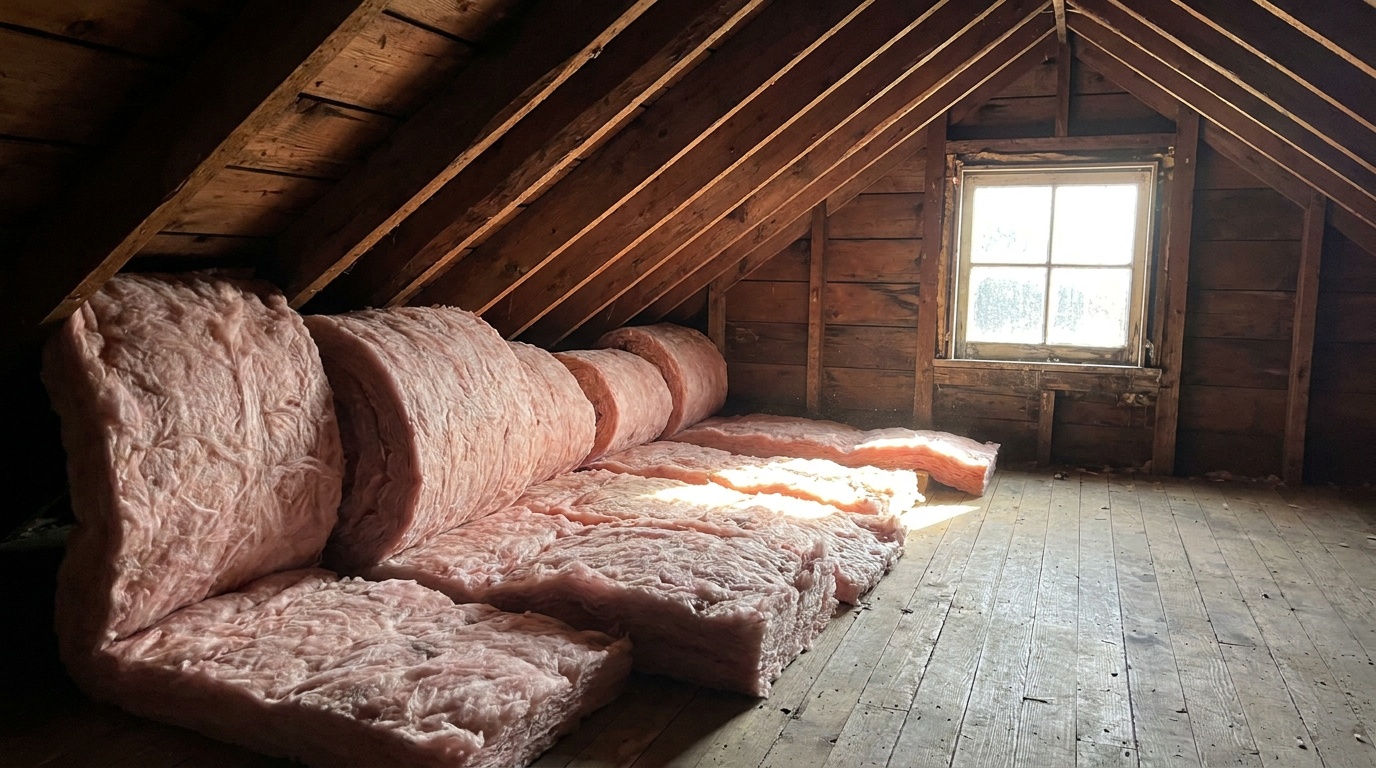
For loft insulation specifically, ECO4 typically covers the cost of installing 270mm of mineral wool insulation — the standard recommended depth — in an accessible loft space. This alone can save households an estimated £150 to £250 per year on heating bills according to the Energy Saving Trust’s 2025 figures.
Why Loft Insulation Matters More Than You Think
Here’s a statistic that should make every homeowner pause: approximately 25% of a home’s heat is lost through the roof in an uninsulated property. That means for every £4 you spend heating your home, £1 is quite literally disappearing into the sky above you.
In 2026, with average household energy bills still hovering around £1,700–£1,900 per year despite recent price cap adjustments, that heat loss translates to real money — roughly £400 to £475 annually being wasted in an uninsulated home. Loft insulation is the single most cost-effective upgrade most homes can receive, with payback periods as short as two to three years even when paying full price.
The UK’s Loft Insulation Gap
Despite the clear financial case, the Energy Efficiency Infrastructure Group estimated in 2025 that around 5.5 million UK homes still have inadequate or no loft insulation. This is particularly concentrated in:
- Pre-1950s terraced housing in northern England and Scotland
- Rural properties in Wales and Northern Ireland
- Privately rented accommodation where landlords delay improvements
- Older homeowners who are unaware of available funding
The environmental dimension matters too. The Climate Change Committee’s 2025 progress report noted that domestic insulation upgrades need to accelerate significantly if the UK is to meet its 2035 carbon targets. ECO4 is a critical delivery mechanism for that ambition — which is why the political will to keep funding it remains strong across party lines.
How to Check Your ECO4 Eligibility
This is the part most people get wrong. They assume they won’t qualify — or they’ve heard the scheme is “only for people on benefits.” The reality is considerably more nuanced, and the eligibility criteria were deliberately broadened in ECO4 compared to its predecessor schemes.
Quick reality check: ECO4 eligibility falls into two main tracks — benefits-based and income-based. Here’s how each works.
Track 1: Benefits-Based Eligibility
If anyone in your household receives one of the following qualifying benefits, you are automatically eligible to apply for ECO4 measures:
- Universal Credit (with an income element below £31,000 per year)
- Pension Credit (Guarantee Credit or Savings Credit)
- Income-based Jobseeker’s Allowance (JSA)
- Income-related Employment and Support Allowance (ESA)
- Income Support
- Child Tax Credit (where household income is below £31,000)
- Working Tax Credit
- Housing Benefit
- Child Benefit (subject to income cap thresholds)
The key word here is anyone. If you’re a working adult living with a partner who receives Universal Credit, your household qualifies even if your own income is higher. This surprises many applicants.
Track 2: The LA Flex Route (Local Authority Flexibility)
Here’s where it gets interesting for people who don’t receive benefits but still struggle with energy costs. Under the Local Authority Flex (LA Flex) mechanism, local councils can refer households to ECO4 funding based on their own criteria. This was designed specifically to capture the “fuel poverty gap” — households in financial difficulty who don’t receive traditional benefits.
LA Flex criteria vary by council but commonly include:
- Low income (typically below £31,000 household income)
- Living in a property with an EPC rating of D, E, F, or G
- Being identified as vulnerable to cold-related health impacts
- Receiving council tax reduction or other local support
Pro Tip: Many people who are declined through the standard ECO4 channel get approved through LA Flex. Always contact your local council’s housing or energy team and apply through a registered ECO4 installer — don’t rely on just one route.
Property Eligibility: What Your Home Needs to Qualify
Your personal financial situation is only half the equation. Your property must also meet certain conditions:
- Must be in England, Scotland, or Wales (Northern Ireland has separate schemes)
- Must have an EPC rating of D or below for most measures (E, F, G properties are prioritised)
- Loft must be accessible with a minimum 50mm of existing insulation or none at all
- Roof must be in reasonable structural condition
- For renters: landlord consent is required
You can check your property’s current EPC rating for free on the government’s EPC register at epcregister.com. If your home doesn’t have a current EPC (valid for 10 years), a registered assessor can provide one, which is often arranged as part of the ECO4 application process itself.
Real Households, Real Savings: Case Studies
Case Study 1: Margaret, 71, Sheffield
Margaret lives alone in a 1930s semi-detached house in Sheffield. She receives Pension Credit and had noticed her energy bills creeping up year after year. Her loft had a thin layer of old fibreglass insulation from the 1980s — far below the recommended 270mm depth. After seeing a leaflet at her GP surgery about ECO4 in early 2025, she contacted a local registered installer.
The assessment took 45 minutes. Within three weeks, a team installed a full top-up to 270mm at no charge. Margaret reported her living room reaching temperature noticeably faster in winter 2025–2026, and her energy bills dropped by approximately £190 over the first heating season. “I just wish I’d known about it sooner,” she said. “It was genuinely straightforward.”
Case Study 2: The Okonkwo Family, Birmingham
Dami and Toyin Okonkwo rent a three-bedroom terraced house in Handsworth, Birmingham. Dami works part-time and receives Working Tax Credit; Toyin is a full-time carer. Their landlord had always deflected requests for insulation upgrades, citing cost. When they discovered that ECO4 would fund the work entirely — and that their landlord would benefit from an improved EPC rating — the dynamic changed.
A local energy charity helped them navigate the landlord consent process. The installation took one day, and the family’s Energy Performance Certificate improved from an E to a C rating. Their estimated saving: £220 per year. The improved EPC rating also gave them stronger standing in any future rental negotiations. “We didn’t realise renters could even access these grants,” Dami noted. “The charity made it real for us.”
The Application Process: Step-by-Step
Applying for ECO4 loft insulation doesn’t require a law degree or a financial adviser. Here’s the practical roadmap:
- Check your eligibility online. Use the Simple Energy Advice (SEA) checker at simpleenergyadvice.org.uk — this government-backed tool takes about five minutes and gives you an initial indication of eligibility based on your benefits, income, and EPC rating.
- Contact your energy supplier directly. The major suppliers all have ECO4 dedicated teams. If you’re with British Gas, E.ON, EDF, Octopus, or OVO, call their energy efficiency line. They will often arrange everything from assessment to installation.
- Find a registered ECO4 installer. Use Ofgem’s list of approved ECO4 suppliers or check TrustMark-registered companies in your area. Be cautious of unsolicited cold callers claiming to offer free insulation — always verify registration independently.
- Book a home assessment. A surveyor will visit your property to confirm loft accessibility, measure existing insulation depth, and assess structural suitability. This is free.
- Review and sign the installation agreement. You’ll receive documentation outlining the work to be done, the funding source, and any conditions. Read it carefully — legitimate ECO4 installers will never ask for upfront payment.
- Installation day. A typical loft insulation installation takes between two and four hours. The installer will clear any obstacles (or ask you to), lay the insulation, and leave the space tidy.
- Post-installation EPC update. Your installer should arrange an updated EPC reflecting the improvement — keep this document safe as it has value for future property sales or rental negotiations.
Timeline to expect: From initial application to completed installation, the typical process in 2026 takes four to eight weeks, though busier periods (particularly autumn and winter) can extend this to ten to twelve weeks.
Common Challenges and How to Overcome Them
Challenge 1: “My Landlord Won’t Agree”
This is the most common barrier for renters. The key is reframing the conversation: landlords benefit from ECO4 installations because they improve the property’s EPC rating, which from 2028 will be legally required to be at least a C for new tenancies under proposed regulations. Approach your landlord with this context — the free upgrade protects their investment and keeps them ahead of incoming legislation.
If your landlord still refuses, contact your local council’s private rented sector team. In some cases, local authorities can apply pressure or offer additional incentives. Energy charities like National Energy Action (NEA) also offer mediation support specifically for this scenario.
Challenge 2: Loft Access Issues
Some properties — particularly certain flat conversions, rooms-in-roof configurations, and some modern builds — have limited or awkward loft access. Don’t assume this rules you out. ECO4 covers a range of insulation types, and a qualified surveyor will assess alternatives. In some cases, room-in-roof insulation (insulating the sloped ceiling rather than a flat loft floor) is funded instead.
Challenge 3: Scams and Rogue Traders
The ECO4 scheme has, unfortunately, attracted unscrupulous operators who misrepresent the scheme to charge hidden fees or deliver substandard work. In 2025, Ofgem received over 1,200 complaints related to ECO4 fraud or malpractice. Protect yourself by:
- Never paying upfront for any ECO4 measure
- Always checking installer registration on the TrustMark or MCS database
- Getting everything in writing before work begins
- Reporting suspicious approaches to Action Fraud (actionfraud.police.uk)
ECO4 vs Other Insulation Grant Options
| Scheme | Funding Level | Eligibility | Who Delivers | Status (2026) |
|---|---|---|---|---|
| ECO4 | Up to 100% free | Benefits / Low income / LA Flex | Energy suppliers | Active — final phase |
| Great British Insulation Scheme | Partial subsidy | EPC D-G, any income | Energy suppliers | Active |
| Warm Homes: Local Grant | Up to 100% | Low income owner-occupiers | Local authorities | Rolling out 2025–2026 |
| Scotland’s HES Warmer Homes | Up to 100% | Scottish households, means-tested | Home Energy Scotland | Active |
| Private installation (no grant) | £0 (full self-pay: £300–£600) | Any homeowner | Private installers | Always available |
Energy Savings: What the Data Shows
The following chart illustrates estimated annual energy bill savings from loft insulation across different property types, based on Energy Saving Trust data updated for 2026 energy prices:
Annual Savings from Loft Insulation by Property Type (2026 estimates)
£220/yr
£270/yr
£160/yr
£195/yr
£255/yr
Source: Energy Saving Trust, 2025–2026 estimates. Based on gas-heated homes upgrading from no insulation to 270mm.
Note that bungalows show disproportionately high savings because the roof-to-floor-area ratio is larger — more of the building envelope is roof. If you live in a bungalow and haven’t insulated your loft, this is arguably the single most impactful home upgrade you can make.
Frequently Asked Questions
Can I apply for ECO4 loft insulation if I own my home outright?
Yes, absolutely. Outright homeowners are eligible just like mortgage holders or renters. What matters is your household income and benefit status, not whether you have a mortgage. Many outright homeowners — particularly older people who paid off their mortgage years ago — live on fixed incomes that qualify them for ECO4. If you receive Pension Credit or have a household income below the relevant threshold, owning your home outright is no barrier to a free loft insulation installation.
What if I already have some loft insulation — can I still get a top-up funded?
Yes, in most cases. If your existing loft insulation is less than 100mm deep (the older standard), you are likely eligible for a funded top-up to the current recommended 270mm under ECO4. The surveyor who assesses your property will measure the depth of existing insulation and confirm eligibility. Homes with very old or deteriorated insulation that no longer performs effectively may also qualify for a full replacement rather than a top-up. Don’t assume partial insulation disqualifies you — it rarely does.
How long will the ECO4 scheme be available, and is there urgency to apply?
ECO4 in its current form runs until March 2026, though a successor scheme (likely ECO5) is expected to follow after a transition period. However, the transition between ECO phases has historically involved gaps in funding and changes to eligibility criteria. Applying now — in early 2026 — means you access the current scheme’s known rules and funding availability. Waiting for ECO5 involves uncertainty about timelines, eligibility changes, and whether your property or circumstances will still qualify under new criteria. The straightforward advice: if you think you might be eligible, check now rather than waiting.
Your Warmth Action Plan: Next Steps
Here’s the straight talk: the information exists, the funding exists, and the pathway is clearer than most people realise. What’s missing for too many eligible households is simply the nudge to act. Consider this yours.
Your five-step action plan for the next two weeks:
- Check your EPC rating this week. Visit epcregister.com, enter your postcode, and find your property’s current rating. If it’s D, E, F, or G — and it almost certainly is if your loft isn’t properly insulated — you’re on the right track for eligibility.
- Use the Simple Energy Advice checker. Visit simpleenergyadvice.org.uk and complete the five-minute eligibility check. Screenshot or print the result — you’ll need it when you contact installers.
- Contact your energy supplier’s ECO4 team directly. Don’t wait for them to find you. Call the dedicated energy efficiency line (found on your supplier’s website) and state explicitly that you want to apply for ECO4 loft insulation.
- Contact your local council’s energy team. Even if the standard ECO4 route seems uncertain, ask about LA Flex referrals. Many councils have dedicated advisors for exactly this purpose — and this route catches many people who fall through the benefits-based eligibility gaps.
- Tell someone you know. If you’re reading this and realise you don’t qualify but someone you know might — an elderly parent, a neighbour on a fixed income, a renting friend — share this with them. The awareness gap is as real as the funding gap.
The broader context matters here: the UK’s journey to net zero runs directly through the nation’s housing stock. Every loft insulated under ECO4 is a small but measurable contribution to carbon reduction targets — and a very direct contribution to one household’s financial resilience. Energy poverty and climate ambition are two sides of the same coin, and schemes like ECO4 exist precisely at that intersection.
You don’t need to navigate this alone, and you don’t need to spend a penny to find out if you qualify. The question worth sitting with is this: what’s the cost of not checking? For most eligible households, it’s measured in cold winters and unnecessary bills — and that’s entirely avoidable.
Article reviewed by Mike O’Brien, Drywall Installation & Surface Finishing Specialist, on May 4, 2026