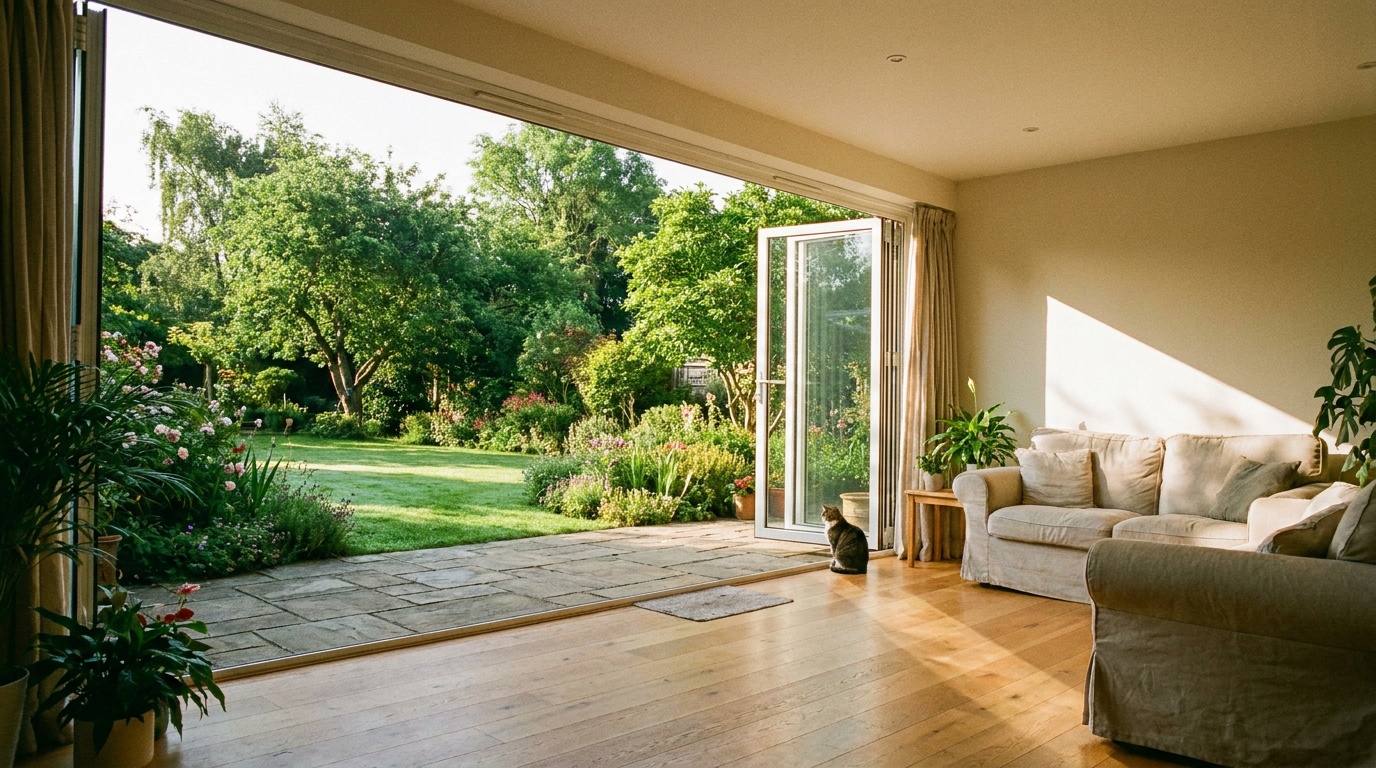
Bi-Fold vs. Sliding Patio Doors: Choosing the Right Fit for UK Homes
Bi-Fold vs. Sliding Patio Doors: Choosing the Right Fit for UK Homes
Reading time: 12 minutes
You’ve finally committed to opening up that back wall. The vision is clear: sunlight flooding in, the garden becoming an extension of your living space, and that seamless indoor-outdoor flow you’ve been pinning on home inspiration boards for months. But then comes the question that stops most UK homeowners in their tracks — bi-fold or sliding patio doors?
It’s not a trivial choice. In 2026, the average UK home improvement project involving rear door installation sits between £3,500 and £14,000 depending on the product, material, and complexity. Get this decision wrong, and you’re not just living with an aesthetic mismatch — you’re potentially dealing with heat loss, wasted space, or a door system that simply doesn’t suit how your family actually moves through the home.
Well, here’s the straight talk: there’s no universally “better” option. What matters is which system is right for your specific home, lifestyle, and priorities. This guide will cut through the marketing noise and help you make a genuinely informed decision.
Table of Contents
- Understanding the Basics: What Makes Each Door Different
- Space, Opening Width, and How You Actually Use the Door
- Thermal Performance, Security, and Weather Resistance
- Real Costs in 2026: Supply, Installation, and Long-Term Maintenance
- Side-by-Side Comparison Table
- What UK Homeowners Are Choosing in 2026
- Real Homes, Real Decisions: Two Case Studies
- Common Challenges and How to Overcome Them
- Frequently Asked Questions
- Making the Right Call: Your Decision Roadmap
Understanding the Basics: What Makes Each Door Different
Before diving into comparisons, it helps to understand what you’re actually dealing with at a mechanical and design level. These aren’t just “big glass doors” — they’re fundamentally different systems with distinct engineering philosophies.
Bi-Fold Doors: The Theatrical Opener
Bi-fold patio doors — sometimes called folding sliding doors or accordion doors — consist of multiple panels (typically 2 to 7) that fold against each other like a concertina when opened. Each panel is connected by hinges and runs along a top or bottom track. When fully opened, the panels stack neatly to one or both sides of the frame, creating an almost entirely unobstructed aperture.
The drama is the point. A fully open bi-fold essentially removes the wall between your home and garden. This is why they’ve been a go-to choice for kitchen extensions and open-plan living spaces since their mainstream emergence in the UK in the mid-2010s. In 2026, manufacturers like Origin, Smart Architectural Aluminium, and Schüco continue to dominate the premium end of the UK bi-fold market with thermally broken aluminium profiles and multi-point locking systems.
Key mechanical features to know:
- Track systems: Top-hung systems (where panels hang from an overhead track) are generally smoother and don’t require floor channels that collect dirt. Bottom-rolling systems are older and more affordable but can be harder to operate over time.
- Traffic door: Most bi-fold configurations include a dedicated “traffic door” — a single panel that opens independently for everyday use without needing to fold the entire system.
- Threshold options: Low-threshold and flush-threshold options are available to meet accessibility requirements under Part M of the UK Building Regulations.
Sliding Patio Doors: The Quiet Performer
Sliding patio doors operate on a simpler mechanical premise: two or more panels where at least one slides horizontally along a track, tucking behind a fixed panel. The sliding panel doesn’t protrude into or outside the space — it simply overlaps with the adjacent fixed panel when open.
Traditional sliding doors were often viewed as dated — a relic of 1980s conservatory culture. But the 2026 landscape looks very different. Modern “lift-and-slide” and “tilt-and-slide” systems from manufacturers like Reynaers, Internorm, and Velfac have transformed the category. These contemporary designs feature ultra-slim sightlines (sometimes as narrow as 20mm), large single panes spanning 3 metres or more, and lifting mechanisms that make even heavy triple-glazed panels glide effortlessly.
Key mechanical features to know:
- Lift-and-slide: The handle mechanism slightly lifts the panel off its bottom seal before sliding, creating a near-airtight seal when closed and effortless operation when opening.
- Inline vs. parallel sliding: Inline systems slide within the same plane; parallel systems bring the moving panel forward slightly before sliding, allowing full clearance of the frame for a wider opening.
- Frame depth: Sliding doors typically require a deeper frame than bi-folds, which can affect how the door integrates with adjacent walls or cabinetry.
Space, Opening Width, and How You Actually Use the Door
This is arguably the most important practical consideration, and it’s one that showrooms don’t always communicate honestly. Ask yourself: how often will you fully open this door, and what do you need from it on a typical Tuesday morning?
Bi-fold doors excel when you genuinely want to erase the boundary between inside and out — for summer garden parties, entertaining, or homes where the kitchen or dining area is in constant visual and physical dialogue with the garden. The wide, dramatic opening is transformative. But here’s the honest caveat: most UK homeowners open their bi-folds fully perhaps 20–30 times per year, given the British climate. For the other 340-odd days, you’re using the traffic door — and that experience matters just as much.
Sliding doors, meanwhile, offer a more proportionate opening. A standard two-panel sliding door opens to roughly 50% of the total width. Inline three-panel configurations can open to 66%. For daily use — stepping out to the garden, letting in fresh air on a mild spring evening — the sliding mechanism is often smoother, quieter, and more intuitive.
Space constraints are a decisive factor. Bi-fold panels need somewhere to stack when open. If your door leads directly onto a narrow patio or you have a garden wall close to the opening, the stacked panels can become a physical obstacle. Sliding doors need lateral wall space to accommodate the panel when open, but this is typically less intrusive.
For very large openings — say, 5 metres or wider — bi-folds remain the more flexible solution, as sliding systems in these widths become extremely heavy and technically complex. However, for openings between 2.4 and 4 metres, both options are equally viable from a technical standpoint.
Thermal Performance, Security, and Weather Resistance
In the UK’s Part L building regulations landscape — which in 2026 continues to push homes towards higher energy efficiency standards ahead of the Future Homes Standard full implementation — glazed door performance matters more than ever. A poorly performing door system can undermine an otherwise well-insulated home.
Energy Efficiency: Where Sliding Doors Hold an Edge
This is a nuanced but important area. Sliding doors, particularly modern lift-and-slide systems, generally achieve lower U-values (the metric for heat loss — lower is better) than bi-fold doors of equivalent frame material. Why? Because sliding doors have fewer frame components and fewer joints. Every hinge and join in a bi-fold panel is a potential thermal bridge and air leakage point.
In 2026, premium aluminium bi-fold doors from reputable UK manufacturers achieve whole-door U-values of approximately 1.4–1.6 W/m²K. By contrast, high-specification lift-and-slide systems can reach 0.8–1.1 W/m²K. For uPVC versions, the gap narrows somewhat, but the principle holds.
That said, a well-manufactured bi-fold with proper installation and high-quality seals will comfortably meet current UK building regulation requirements (maximum 1.6 W/m²K for replacement doors in existing dwellings as of 2026). The performance gap becomes significant mainly when homeowners are targeting Passivhaus standards or high EPC ratings for sale or rental purposes.
Security Considerations
Both systems, at the premium end, offer excellent security. Look for:
- Multi-point locking: Standard on quality bi-folds and sliding doors, securing the panel at multiple points along its height.
- Shootbolts and anti-lift pins: Essential anti-intrusion features, particularly for ground-floor installations.
- PAS 24 accreditation: The UK security standard for enhanced door security. In 2026, this is a baseline requirement for Building Regulations compliance in new builds and many extensions.
- Laminated inner pane: Adds a critical layer of security; even if the glass breaks, the laminate holds it together, resisting forced entry.
One practical security note: bi-fold doors with more panels have more potential weak points at the joins between panels. Quality hinges and anti-lift mechanisms are non-negotiable. Sliding doors, with fewer moving parts, are marginally easier to secure robustly, though the difference is negligible with reputable products.
Weather Resistance in the British Climate
The UK’s 2026 climate — wetter winters, more intense summer rainfall events, and periodic high winds — demands robust weather sealing. Bi-fold doors have traditionally been criticised for water ingress at the base track, particularly in older or budget installations. Modern top-hung systems with low-threshold designs have substantially addressed this, but it remains important to verify the weather rating (tested to BS 6375) before purchasing.
Lift-and-slide doors create a tight compression seal when the handle is engaged, making them particularly resistant to wind-driven rain. For homes in exposed coastal or elevated positions — think the Yorkshire Moors, the Cornish coast, or rural Scottish settings — this is a meaningful advantage.
Real Costs in 2026: Supply, Installation, and Long-Term Maintenance
Let’s talk money. The UK door and window market in 2026 has seen sustained price pressure from aluminium and glass supply chain costs, partially offset by increased manufacturing competition. Here’s a realistic picture of what you’ll spend:
Bi-fold doors (aluminium, thermally broken, triple-glazed):
- 3-panel system (2.4m wide): £3,800–£6,500 supply and fit
- 4-panel system (3.2m wide): £5,200–£8,500 supply and fit
- 5-panel system (4m wide): £6,500–£11,000 supply and fit
Sliding doors (aluminium lift-and-slide, triple-glazed):
- 2-panel system (2.4m wide): £2,800–£5,500 supply and fit
- 3-panel system (3.6m wide): £4,500–£9,000 supply and fit
- Large format (4.8m+ wide): £8,000–£14,000+ supply and fit
uPVC versions of both types are available at 30–50% lower cost but with different aesthetic and longevity characteristics. In 2026, aluminium remains the material of choice for the majority of UK new-build and extension projects due to its slim sightlines, durability, and low maintenance profile.
Maintenance costs over a 10-year period are broadly similar for both door types when quality products are properly installed. Key maintenance tasks include track cleaning, seal inspection, and lubrication of moving parts — typically a couple of hours per year at negligible cost.
Side-by-Side Comparison Table
| Metric | Bi-Fold Doors | Sliding Patio Doors |
|---|---|---|
| Maximum Opening Width | Up to 8m+ (multi-panel) | Typically up to 6m (practical limit) |
| Thermal Performance (U-value) | 1.4–1.6 W/m²K (premium alu) | 0.8–1.2 W/m²K (lift-and-slide) |
| Typical Supply & Fit Cost | £3,800–£11,000 (3–5 panel) | £2,800–£14,000+ (2–3 panel) |
| Ease of Daily Use | Good (via traffic door) | Excellent (smooth glide) |
| Weather Sealing | Good–Very Good (top-hung) | Excellent (lift-and-slide) |
What UK Homeowners Are Choosing in 2026
Based on 2025–2026 sales data from the Glass and Glazing Federation (GGF) and market analysis from leading UK installation networks, here’s how consumer preference breaks down by door system for rear patio access in residential properties:
UK Patio Door Market Share by Type (2026)
38%
32%
15%
10%
5%
Source: Glass and Glazing Federation market data, 2025–2026
The data tells an interesting story. Aluminium bi-folds still lead the market, but lift-and-slide systems have grown from approximately 21% market share in 2022 to 32% in 2026 — a reflection of improved product availability, greater consumer awareness of thermal performance, and architectural trends favouring sleeker, minimalist aesthetics.
Real Homes, Real Decisions: Two Case Studies
Case Study 1: The Kitchen Extension in Leeds
Sarah and James completed a single-storey rear extension on their 1930s semi-detached home in Headingley, Leeds, in early 2025. Their brief was clear: connect the new kitchen-diner to the garden, maximise natural light, and create a space their three children could move through freely.
They initially favoured sliding doors for their thermal performance — the couple had invested in an air source heat pump and wanted the building fabric to support it. However, after measuring the available opening (3.8 metres wide) and consulting with their architect, they chose a 4-panel aluminium bi-fold with a traffic door configuration. The reasoning was practical: with three kids and a dog, the wide opening made sense for summer. The traffic door handled day-to-day use, and the Origin OB-49 system they selected achieved a U-value of 1.5 W/m²K — within their energy efficiency targets.
Total cost: £7,200 supply and fit. “We were worried bi-folds would look too commercial,” Sarah recalls, “but with the slim aluminium frames in anthracite grey, it actually looks incredibly modern. We use the full opening probably every other weekend from May to September.”
Case Study 2: The Coastal Cottage in Cornwall
Mark, a retired architect, retrofitted his Grade II listed cottage near St Ives with a carefully specified glazing system in 2026. Planning permission constraints limited the opening to 2.6 metres wide. His priorities were weather resistance (the property faces the Atlantic), energy retention, and minimal visual disruption to the period character of the building.
Mark chose a two-panel Reynaers Hi-Finity lift-and-slide system with warm-edge spacer bars and triple glazing, achieving a whole-door U-value of 0.98 W/m²K. The ultra-slim 20mm sightlines satisfied both his aesthetic instincts and the planning officer. “For this specific context — coastal exposure, heritage setting, and a modest opening width — the sliding system was unambiguously the right choice,” he explains. “The compression seal is exceptional. We’ve had 70mph gusts this winter and not a whisper of a draught.”
Total cost: £8,400 supply and fit, reflecting the premium specification and planning compliance requirements.
Common Challenges and How to Overcome Them
Challenge 1: Track Dirt and Maintenance Issues
One of the most common complaints about both bi-fold and sliding doors — particularly from homeowners in their second or third year of ownership — is debris accumulation in the bottom track. Leaves, garden soil, and grit can impede smooth operation and cause premature wear.
Solution: If bi-folds are your choice, prioritise a top-hung system from the outset. This eliminates the structural load from the bottom track (which becomes purely a guide rail) and dramatically reduces the accumulation of operational grit. For sliding doors, look for systems with removable track inserts that allow for thorough cleaning. A quarterly clean with a stiff brush and mild detergent, followed by track lubrication with a silicone-based spray, keeps both systems running smoothly.
Challenge 2: Condensation and Glazing Performance
Internal condensation on the inner face of the glass is a sign of inadequate thermal performance — either in the glazed unit itself or in the frame. In 2026, this is most commonly seen in older double-glazed systems or budget uPVC installations.
Solution: Specify warm-edge spacer bars (which replace the traditional aluminium spacer at the glass perimeter with a thermally efficient alternative) and ensure the overall system U-value is below 1.4 W/m²K for new installations. If you’re in a high-humidity home (cooking, bathroom proximity, or many occupants), consider a heat recovery ventilation system to manage internal moisture levels holistically.
Challenge 3: Planning Permission Misunderstandings
A surprisingly common issue in 2026: homeowners assume that replacing existing patio doors automatically falls under permitted development rights, then discover mid-project that their local authority has specific requirements — particularly in conservation areas, on listed buildings, or where the extension itself required planning permission.
Solution: Before specifying any door system, submit a Lawful Development Certificate application or contact your local planning department directly. Most councils now offer pre-application advice services. In conservation areas, aluminium frames may require colour approval, and glass reflectivity specifications may be controlled. Getting this clarity early saves costly specification changes later.
Frequently Asked Questions
Do bi-fold doors add value to a UK home in 2026?
Yes, but with important caveats. A well-specified, professionally installed bi-fold door system as part of a kitchen extension or open-plan living conversion can add between 5–8% to property value, according to 2025 research from Nationwide’s housing division. However, the value addition is tied to the quality of the overall project rather than the door type in isolation. A budget bi-fold poorly integrated into a dated kitchen will add minimal value. The door choice needs to be coherent with the broader design narrative of the space.
Which door type is better for homes with young children or elderly residents?
For accessibility and daily ease of use, modern lift-and-slide doors have a slight edge. The single smooth operating motion — turn the handle, glide open — is more intuitive and requires less physical coordination than navigating a bi-fold traffic door, particularly for elderly residents or young children learning independence. Both systems can achieve flush or low thresholds to meet Part M accessibility requirements. If the primary concern is accessibility, ensure you specify a flush threshold specifically and confirm the installer has experience fitting these correctly, as improper installation remains the most common source of trip hazards.
Can I install either door type in a period or listed property?
Both can be installed in period properties, but the process differs significantly. In conservation areas and for listed buildings, planning permission is almost certainly required regardless of door type. Sliding doors with slim sightlines and low visual impact are often more readily approved in sensitive heritage contexts, as they can be read as a contemporary “addition” rather than a replacement of original fabric. Bi-folds, with their more industrial concertina appearance, can meet greater resistance from conservation officers. Timber versions of both door types — though considerably more expensive at £15,000–£25,000 for quality joinery — are generally the most sympathetically received in listed building applications. Always engage a heritage consultant or experienced architect before proceeding.
Making the Right Call: Your Decision Roadmap
Choosing between bi-fold and sliding patio doors isn’t about which product is objectively superior — it’s about matching the right system to your specific home, climate, lifestyle, and budget. As UK homes evolve toward higher energy standards and more considered indoor-outdoor living, both door types continue to improve. The gap in performance and aesthetics between them has narrowed considerably in 2026, which is actually good news: it means either choice, made thoughtfully, will serve you well.
Here’s your practical decision roadmap:
- Define your opening width and stacking constraints first. Measure the available wall space for panels to stack into when open. If it’s tight, sliding doors are your friend. If you have the room and want the drama of a full opening, bi-folds deliver.
- Check your energy efficiency targets. If you’re aiming for a high EPC rating, pursuing Passivhaus standards, or have a heat pump system to protect, prioritise a lift-and-slide system with a sub-1.2 W/m²K U-value. If standard compliance is sufficient, premium bi-folds will meet the brief.
- Consider how you’ll use the door daily, not just on special occasions. Visit a showroom and operate both systems repeatedly. Notice which feels more natural. The “wow factor” of a fully open bi-fold is real — but so is the quiet satisfaction of a perfectly balanced sliding door that glides open with one finger.
- Get three competitive quotes and verify PAS 24 accreditation. In 2026, the UK installation market remains fragmented. Insist on PAS 24 compliance, check for FENSA registration, and ask specifically about the threshold specification and weather performance data.
- Plan for the long term. Both systems have 20–30 year lifespans when properly maintained. Think about how your needs might evolve — young families become families with teenagers and eventually become homes for older occupants. Accessibility provisions now may be genuinely valuable later.
As UK building standards continue tightening through 2027 and beyond under the Future Homes Standard, the energy performance of every element of a home’s fabric will matter more — and doors like these will be increasingly scrutinised in EPC assessments and mortgage lending decisions tied to energy ratings.
So here’s the question worth sitting with: Which door will you still love on a grey November Tuesday, not just a sun-drenched Saturday in July? Answer that honestly, and you’ll make the right choice.
Article reviewed by Mike O’Brien, Drywall Installation & Surface Finishing Specialist, on May 4, 2026