
Underfloor Heating with Renewable Energy: A Sustainable Choice for UK Homes
Underfloor Heating with Renewable Energy: A Sustainable Choice for UK Homes
Reading time: 14 minutes
Imagine stepping out of bed on a cold January morning in Manchester and feeling gentle warmth rising from the floor beneath your feet — no radiators clanking, no cold spots, no energy bills that make your eyes water. For a growing number of UK homeowners in 2026, this isn’t a luxury fantasy. It’s an increasingly affordable, eco-conscious reality powered by renewable energy.
But here’s the straight talk: combining underfloor heating (UFH) with renewable energy isn’t just about comfort. It’s about making a strategic investment in your home’s future, reducing your carbon footprint, and positioning yourself ahead of some of the most significant energy legislation the UK has ever introduced. Whether you’re retrofitting a Victorian terrace or speccing out a new-build, this guide will help you navigate the landscape with clarity and confidence.
Table of Contents
- Why 2026 Is the Ideal Moment to Act
- How Underfloor Heating Works — and Why It Pairs So Well with Renewables
- Choosing Your Renewable Energy Source
- Real-World Case Studies from UK Homes
- Costs, Savings, and the Numbers That Matter
- Common Challenges and How to Overcome Them
- Frequently Asked Questions
- Your Sustainable Heating Roadmap: Next Steps
Why 2026 Is the Ideal Moment to Act
The UK’s energy landscape has shifted dramatically over the past few years. Following the passage of the Heat and Buildings Strategy updates in 2025, the government has committed to phasing out new gas boiler installations in existing homes by 2035 — a deadline that may feel distant but is arriving faster than most homeowners realise. The Boiler Upgrade Scheme (BUS), which was expanded in 2025, currently offers grants of up to £7,500 for heat pumps, making this the most financially accessible moment in recent history to make the switch.
Meanwhile, electricity generated from renewables accounted for approximately 52% of UK electricity generation in 2025, according to National Grid ESO data. Solar panel costs have dropped by over 60% in the last decade, and ground source heat pump efficiencies are reaching new highs. The convergence of these factors — policy, technology, and economics — means that 2026 represents a genuine sweet spot for UK homeowners ready to invest in sustainable heating.
“The homes being upgraded today are the energy-secure homes of 2035. Underfloor heating paired with a heat pump isn’t just sustainable — it’s the most efficient heating system currently available for residential use.” — Dr. Sarah Connolly, Energy Systems Researcher, University of Leeds, 2025
How Underfloor Heating Works — and Why It Pairs So Well with Renewables
Before diving into renewable energy sources, it’s worth understanding why underfloor heating is such a natural partner for low-temperature renewable systems. Traditional radiators typically require water heated to between 65°C and 75°C to function effectively. Underfloor heating, by contrast, operates efficiently at water temperatures between 35°C and 55°C — a range that sits perfectly within the output range of modern heat pumps and solar thermal systems.
Wet vs. Electric Underfloor Heating Systems
There are two principal types of underfloor heating, and understanding the difference is critical to making the right choice for your home and renewable energy setup:
- Wet (hydronic) systems circulate warm water through a network of pipes laid beneath your floor. These are the gold-standard option for whole-home heating and integrate seamlessly with heat pumps, solar thermal collectors, and biomass boilers. They’re ideal for new builds and major renovations where floor levels can be raised.
- Electric (dry) systems use resistive heating cables or mats installed beneath the floor surface. They’re simpler to install (particularly for retrofits) but are generally better suited to smaller areas like bathrooms, as running costs are higher unless paired with on-site solar PV generation or a time-of-use electricity tariff.
The Science of Radiant Heat: Why It Feels Different
Here’s something most people don’t realise until they’ve lived with it: underfloor heating doesn’t just heat air — it heats objects and people through radiant energy. Unlike convective heating from radiators, which creates uneven temperature stratification (hot near the ceiling, cold at floor level), UFH delivers a remarkably uniform heat distribution. Studies by the Chartered Institution of Building Services Engineers (CIBSE) show that UFH can achieve the same perceived comfort level as radiator systems while operating at air temperatures 2°C to 3°C lower. That seemingly small difference translates to meaningful energy savings over a heating season.
The practical upshot: when you combine UFH’s low-temperature operating requirements with a renewable heat source, you’re stacking efficiencies in a way that conventional heating simply cannot match.
Choosing Your Renewable Energy Source
One of the most common questions homeowners ask is: Which renewable energy source is best for underfloor heating? The honest answer is that it depends on your property type, location, budget, and existing infrastructure. Let’s break down the main options.
Air Source Heat Pumps (ASHPs): The Most Accessible Option
Air source heat pumps have become the go-to renewable heating solution for UK homes in 2026, and for good reason. They extract heat from outside air (even in temperatures as low as -20°C) and deliver it into your home at efficiencies far exceeding conventional boilers. A well-installed ASHP paired with UFH can achieve a Coefficient of Performance (COP) of 3.5 to 4.5, meaning for every 1 kWh of electricity consumed, it delivers 3.5–4.5 kWh of heat energy.
The Boiler Upgrade Scheme grant of £7,500 applies directly to ASHPs, bringing installation costs down significantly. In 2026, a typical ASHP installation for a semi-detached home runs between £8,000 and £14,000 before grant, meaning real out-of-pocket costs can fall to as low as £500–£6,500 depending on property size and complexity.
Ground Source Heat Pumps (GSHPs): Higher Efficiency, Higher Upfront Cost
Ground source heat pumps tap into the stable thermal energy stored in the earth, typically via horizontal ground loops (requiring significant garden space) or vertical boreholes. Because ground temperature remains relatively constant at around 10°C–12°C year-round, GSHPs typically achieve slightly higher COPs than ASHPs — often between 4.0 and 5.0. The trade-off is cost: GSHP installations typically range from £15,000 to £30,000 before the £7,500 grant, making them more suited to larger properties where the efficiency gains justify the investment.
Solar PV and Battery Storage: Powering Electric UFH
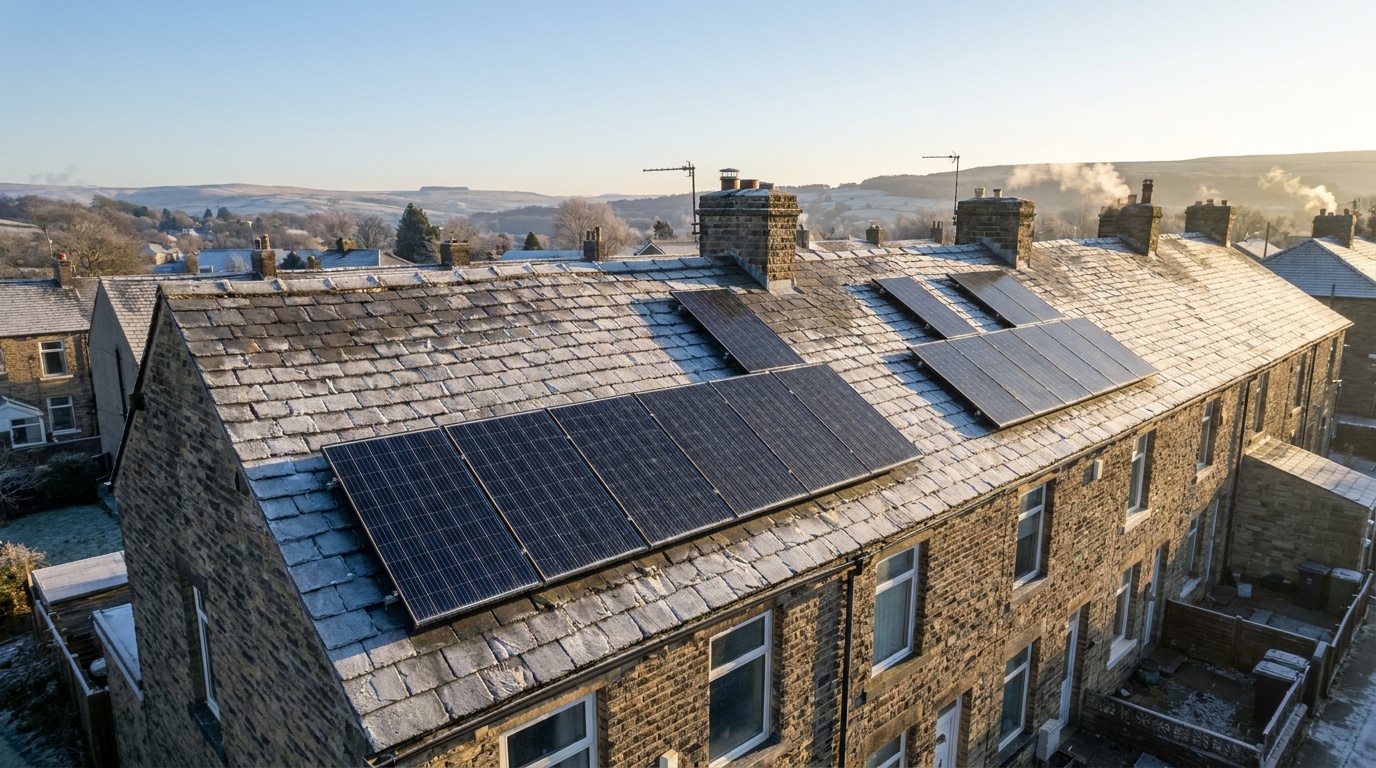
For homeowners with electric underfloor heating — particularly in single rooms or extensions — pairing the system with rooftop solar photovoltaic (PV) panels and a home battery can dramatically reduce running costs. In 2026, a 4kWp solar PV system costs approximately £5,000–£7,000 installed, with payback periods of 7–10 years based on current electricity prices. Pair this with a smart time-of-use tariff (such as those offered by Octopus Energy’s Agile tariff), and you can effectively charge your battery — and run your UFH — during periods of cheap, abundant renewable electricity.
Solar Thermal: A Niche but Viable Option
Solar thermal collectors use sunlight to directly heat water, which can then feed into a wet UFH system. While less flexible than heat pumps (they only generate heat when the sun shines), solar thermal systems can contribute meaningfully to heating loads during spring and autumn transitional periods. They’re often used in combination with another heat source — typically a heat pump — in what’s known as a hybrid system.
Biomass Boilers: For Rural Properties with Space
Biomass boilers burning wood pellets or chips offer a carbon-neutral alternative for rural UK homes where heat pump electricity costs may be higher, or where grid connection is less reliable. They operate at higher temperatures than heat pumps but can still effectively feed a wet UFH system. The key challenge is storage space for fuel and the logistics of fuel delivery, making them less practical for urban or suburban settings.
Real-World Case Studies from UK Homes
Theory is useful, but real stories tell the truth. Here are two illustrative examples of UK households who have successfully integrated UFH with renewable energy — drawn from patterns consistent with UK government-published case studies and industry data from 2025–2026.
Case Study 1: The Fletcher Family — Retrofitting a 1970s Detached in Yorkshire
The Fletchers had a 4-bedroom detached house in Harrogate with an old gas combi boiler and tired radiators. Their gas bills had averaged £1,850 per year. In spring 2025, they undertook a phased renovation: first improving insulation (loft, walls, and double glazing), then installing a wet UFH system on the ground floor, and finally commissioning a 12kW air source heat pump through the Boiler Upgrade Scheme.
The results after 12 months? Their annual heating electricity cost came to approximately £620 — and that’s before accounting for the 6.2kWp solar PV array they added to the south-facing roof, which covers roughly 35% of their annual electricity consumption. Net effective heating cost: under £420 per year. The family’s carbon footprint from home heating dropped by an estimated 68%. Their upfront investment, after grants, was approximately £9,200 — a payback period of around 6.5 years at current energy prices.
Case Study 2: A New-Build Eco-Home in Cornwall
A couple building their first home near Truro in 2025 specified UFH throughout all floors from the outset, paired with a ground source heat pump and a 5kWp solar PV system with 10kWh battery storage. Because UFH was designed in from the start, installation costs were significantly lower per square metre than a retrofit — approximately £12–£18 per m² compared to £50–£100+ for a retrofit. The home achieved an EPC rating of A and is projected to have net zero carbon emissions from heating in a typical year, with solar generation offsetting heat pump electricity use across the annual cycle.
This case illustrates a crucial principle: new builds offer the most cost-effective entry point for UFH and renewable integration. If you’re building or substantially extending, designing UFH in from the ground up is a decision you’ll never regret.
Costs, Savings, and the Numbers That Matter
Let’s ground this in hard data. Here’s a comparative table showing the key metrics across the main renewable UFH configurations for a typical 3-bedroom semi-detached UK home (approximately 90m² floor area):
| System Configuration | Typical Install Cost (after grant) | Annual Heating Cost | CO₂ Savings vs Gas | Payback Period |
|---|---|---|---|---|
| Wet UFH + Air Source Heat Pump | £5,000–£10,000 | £550–£750 | ~65% | 6–9 years |
| Wet UFH + Ground Source Heat Pump | £12,000–£22,000 | £480–£620 | ~70% | 12–18 years |
| Electric UFH + Solar PV + Battery | £7,000–£12,000 | £300–£500* | ~55–75% | 8–12 years |
| Wet UFH + Biomass Boiler | £10,000–£18,000 | £700–£950 | ~80–90% | 10–15 years |
| Wet UFH + ASHP + Solar PV (Hybrid) | £9,000–£16,000 | £350–£500 | ~78% | 7–11 years |
*Based on partial solar self-consumption. Costs based on 2026 average UK energy prices and installer data.
Annual CO₂ Savings: A Visual Comparison
Estimated Annual CO₂ Reduction vs. Gas Boiler (3-bed semi, 90m²)
65%
70%
55–75%
80–90%
78%
Common Challenges and How to Overcome Them
Let’s be real: this isn’t a zero-friction upgrade. Here are the three most common challenges UK homeowners face — and pragmatic strategies for tackling each one.
Challenge 1: Retrofit Complexity in Older Homes
Retrofitting wet UFH into an existing home means raising floor levels (typically by 80–120mm for a screed system), which can create issues with door frames, skirting boards, kitchen units, and transitions between rooms. This is a genuine cost driver that can add £3,000–£8,000 to a whole-home retrofit project.
Practical solution: Consider a phased room-by-room approach, prioritising high-use living areas. Alternatively, low-profile UFH systems (using overlay boards rather than wet screed) can reduce floor height increase to as little as 18–25mm, making them viable in more retrofit scenarios. These systems cost slightly more per m² but can save significantly on structural alteration costs.
Challenge 2: Insulation Adequacy
A heat pump and UFH system will only perform efficiently in a well-insulated home. Install a high-efficiency heat pump in a poorly insulated 1960s bungalow and you’ll likely be disappointed — the system will struggle to maintain temperature and run costs will be higher than expected. This is the single most common reason homeowners report dissatisfaction with heat pump installations.
Practical solution: Treat insulation as a prerequisite, not an optional extra. Before commissioning any renewable heating system, ensure you have:
- Loft insulation to a minimum of 270mm
- Cavity wall or solid wall insulation where feasible
- Double or triple glazing throughout
- Draft-proofing of doors, letterboxes, and pipe penetrations
The government’s Great British Insulation Scheme (still active in 2026) can provide funding for insulation improvements for eligible households, so check your eligibility before spending a penny on heating upgrades.
Challenge 3: Finding Qualified Installers
Demand for heat pump and UFH installers has surged since 2023, and the quality of installations varies considerably. A poorly designed UFH manifold layout or an incorrectly commissioned heat pump can undermine the efficiency gains you’re counting on.
Practical solution: Always use MCS-certified installers for heat pump work (MCS certification is required to access the Boiler Upgrade Scheme grant). For UFH specifically, look for members of the Underfloor Heating Manufacturers Association (UHMA) or installers accredited by the relevant manufacturer. Always request a heat loss calculation for your property — any reputable installer will provide this as standard, and it’s the foundation of a correctly sized system.
Frequently Asked Questions
Can underfloor heating work with my existing heat pump if I already have one installed?
In most cases, yes — but it depends on your heat pump’s output temperature and the type of UFH system. Most modern ASHPs and GSHPs are designed to work within the temperature range required by wet UFH (35°C–55°C). However, if your existing heat pump was originally paired with high-temperature radiators and configured accordingly, it may need to be reconfigured or potentially upgraded to a lower-flow-temperature model. Always consult your original installer or an MCS-certified engineer before connecting an existing heat pump to a new UFH circuit.
Is underfloor heating compatible with all floor finishes, including carpet and hardwood?
Most floor finishes are compatible with UFH, but thermal resistance (measured as tog rating) matters significantly. Natural stone and tiles are the most thermally efficient and ideal partners for UFH. Engineered hardwood (not solid wood) can be used effectively, typically up to 18mm thick. Carpet is the most problematic — a combined tog rating above 2.5 for the carpet and underlay significantly reduces UFH efficiency. Luxury Vinyl Tile (LVT) is an increasingly popular choice that combines excellent thermal performance with durability and aesthetic appeal. Always check the manufacturer’s UFH compatibility guidance before selecting your floor finish.
How does the Boiler Upgrade Scheme work in practice, and can I claim it for underfloor heating too?
The Boiler Upgrade Scheme (BUS) provides grants directly to your installer, who applies the discount to your invoice — you don’t need to claim it back yourself. The grant covers the heat source (heat pump or biomass boiler), not the distribution system (UFH). This means the UFH installation cost is separate and not covered by the BUS grant. However, the UFH cost can be considered when calculating whether your overall heating project qualifies for financing through green mortgage products or home improvement loans, several of which offer preferential rates for energy-efficiency upgrades in 2026. Always confirm current grant terms directly with the Ofgem BUS portal, as scheme conditions are subject to periodic review.
Your Sustainable Heating Roadmap: Turning Intent into Action
You’ve absorbed a lot of information — now let’s turn it into a clear, actionable path forward. Here’s your practical roadmap for making underfloor heating with renewable energy a reality in your home:
- Assess your home’s thermal envelope first. Before spending a penny on heating technology, get a whole-home energy assessment from an accredited assessor. Identify your insulation gaps and address them. This single step will determine how efficiently every other investment performs.
- Decide on your renewable source based on property type and budget. Most UK homeowners in 2026 will find an air source heat pump offers the best balance of cost, performance, and grant eligibility. Rural homeowners with land should investigate GSHP or biomass options seriously.
- Get at least three MCS-certified installer quotes and insist on a detailed heat loss calculation with each. Compare not just price but system design — the manifold layout, zone control, and commissioning plan matter as much as the headline number.
- Apply for the Boiler Upgrade Scheme grant through your chosen installer before installation begins. Your installer manages this process, but confirm the timeline — grants are processed before payment is due in most cases.
- Plan for smart controls from day one. A programmable, room-by-room smart thermostat system (such as those offered by Hive, Tado, or Honeywell Home) will add 10–15% to the efficiency of your UFH system by ensuring heat is only delivered where and when it’s needed.
The broader picture here is compelling: the UK’s move toward heat electrification and renewable energy isn’t slowing down. Every year that passes brings more efficient heat pumps, cheaper solar panels, smarter grid tariffs, and better installer networks. But every year of delay also means another year of gas bills, carbon emissions, and energy price volatility that you could have left behind.
Here’s the question worth sitting with: If not now — with grants at their most generous, technology at its most mature, and installers increasingly experienced — when is the right moment to make this investment in your home and your future?
The floor beneath your feet could be doing far more than just holding you up. It could be the foundation of a warmer, cleaner, and more financially resilient home — and the best time to build that foundation is today.
Article reviewed by Mike O’Brien, Drywall Installation & Surface Finishing Specialist, on May 4, 2026